News archive
BOINC client 8.2.4 released
The 8.2.4 version of the BOINC client has been released for all platforms. Download it here. Release notes are here. The new version supports Docker apps - an important step for BOINC.
10 Jul 2025, 21:46:02 UTC
· Discuss
Lines of code visualization
Vitalii made a visualization of the number of lines of code in BOINC going back to 2002.
16 Mar 2025, 9:07:20 UTC
· Discuss
Grafana project dashboards
Check out Grafana project dashboards showing time-varying graphs of project info such as number of unsent and in-progress jobs.
15 Feb 2025, 21:03:13 UTC
· Discuss
Contributor history video
Vitalii made a video showing the top 25 BOINC committers, based on CVS, Subversion and Git data, every month going back to 2002.
2 Jan 2025, 3:33:26 UTC
· Discuss
50 new papers from Rosetta@home
David Baker's research group published over 50 journal papers since our last update. Wow! (And thanks to Alex Piskun for maintaining the list of publications by BOINC projects.)
27 Dec 2024, 20:29:57 UTC
· Discuss
Rosetta@home leader wins Nobel Prize
Dr. David Baker of the University of Washington, creator of Rosetta@home, has won the 2024 Nobel prize in Chemistry. Congratulations!
9 Oct 2024, 23:23:34 UTC
· Discuss
Should BOINC boycott Russian projects?
This has been suggested. We're not going to do it, but the idea merits thought and discussion.
10 Sep 2024, 2:18:10 UTC
· Discuss
Windows malware reported
We have received several reports of malware that installs and runs the 8.0.2 BOINC client on Windows computers. We are investigating this; we currently don't know how the malware works or how to defeat it. We'll report whatever we learn here.
This is not a vulnerability in BOINC; rather, it's malware that illegally installs BOINC.
26 Jun 2024, 23:01:38 UTC
· Discuss
User Manual moved to Github
As part of our effort to move documentation to Github, we have moved the User Manual from Mediawiki on the UCB server to Markdown on Github.
15 Jun 2024, 21:26:02 UTC
· Discuss
BOINC client 8.0.2 released
The 8.0.2 version of the BOINC client has been released for all platforms. Download it here. Release notes are here.
30 May 2024, 11:07:49 UTC
· Discuss
BOINC Workshop 2024
The 20th annual BOINC Workshop will be held 29-31 May,
at CERN in Geneva. Learn more and register.
30 Apr 2024, 5:26:29 UTC
· Discuss
BOINC wins a prize
BOINC is a prize winner in the WSIS competition for E-Science projects. Congratulations to all of us!
18 Apr 2024, 3:11:38 UTC
· Discuss
BOINC needs your vote (by Thu 4 April) for a UN-sponsored award
The World Summit on the Information Society (WSIS) is a United Nations-sponsored initiative aimed at building inclusive and equitable information societies worldwide. BOINC has been nominated for a prize at the 2024 WSIS forum, and has passed initial hurdles; the last step involves public voting.
Vote for BOINC! Instructions are here.
25 Mar 2024, 22:06:52 UTC
· Discuss
BOINC in schools
Registration is open for The Computation Moonshot, a competition for high schools which encourages students to learn about scientific computing.
13 Feb 2024, 9:36:35 UTC
· Discuss
YouTube video on BOINC server setup
A new YouTube video shows how to set up a BOINC server. Thanks to Alex Bryan for producing this.
11 Feb 2024, 21:04:50 UTC
· Discuss
BOINC 7.24.3 released for Mac
This version fixes a problem that causes GPU apps to fail after a Mac OS upgrade to Sonoma. Download it here.
30 Jan 2024, 20:27:45 UTC
· Discuss
BOINC-related paper published
A paper about public participation in science (including BOINC) was published in PLOS One.
22 Nov 2023, 21:47:24 UTC
· Discuss
Einstein@home launches Zooniverse project
Einstein@home has launched a Zooniverse project called "Pulsar Seekers" to help classify radio pulsar candidates.
13 Nov 2023, 20:48:31 UTC
· Discuss
BOINC client 7.24.2 released for Mac
This release fixes problems with the BOINC screensaver on MacOS 14.0 Sonoma. We recommend that you install it if you use that version of MacOS.
30 Oct 2023, 6:19:22 UTC
· Discuss
Promo materials from SCI
The Science Commons Initiative has created some images that you can use to make posters and flyers about BOINC, and also videos about installing BOINC on Windows and Mac. See it all here.
16 Oct 2023, 9:03:26 UTC
· Discuss
MacOS 14 Sonoma breaks BOINC screensaver
The screensaver doesn't exit properly. To force it to exit, hold down the command and shift keys while pressing Q to log out of the system, then log back in.
We hope to fix this problem soon. Until then, if you run MacOS 14, disable the BOINC screensaver.
8 Oct 2023, 21:48:16 UTC
· Discuss
BOINC client 7.24.1 released
The 7.24.1 version of the BOINC client software has been released for Windows, Mac, and Android. Download it here. Release notes are here. Thanks to everyone who contributed to developing and testing this release.
7 Sep 2023, 22:17:32 UTC
· Discuss
Video and paper from The Ramanujan Machine
Check out a new video and paper from The Ramanujan Machine, which has used BOINC to discover new expressions for fundamental mathematical constants.
31 Aug 2023, 19:04:48 UTC
· Discuss
Italian Masters thesis on BOINC
Check out The democratization of science: Analysis of the voluntary distributed
computing platform BOINC, a Masters thesis by Antonio Cerrato. Also in the original Italian.
6 Aug 2023, 16:13:06 UTC
· Discuss
Client version 7.22 released
A new version of the BOINC client is available for Windows, Mac, and Android. Download it here. Release notes are here. Thanks to BOINC volunteer developers and testers.
21 Jun 2023, 23:20:38 UTC
· Discuss
Control BOINC from Home Assistant
A control for BOINC is available for the Home Assistant home automation system, making it possible to control BOINC in response to various environmental factors.
30 May 2023, 7:58:34 UTC
· Discuss
Welcome YAFU
The goal of the YAFU project is to factor numbers of up to 149 digits which are needed to bring Aliquot Sequences to a size of at least 140.
25 Apr 2023, 8:26:52 UTC
· Discuss
BOINC wiki now on Github
The BOINC wiki, which contains technical documentation for scientists and developers, has been moved from Trac to the BOINC Github repository.
25 Apr 2023, 0:14:28 UTC
· Discuss
BOINC workshop video
A video of the recent BOINC workshop is now available on YouTube.
16 Mar 2023, 8:06:31 UTC
· Discuss
BOINC Workshop 2023 to be held March 1 and 8
The annual BOINC Workshop aims to stimulate new developments and activities related to volunteer computing, and to guide the future development of BOINC.
Date: March 1 and 8, for 3 hours each day
Time: 09:00 PST / 11:00 CST / 12:00 EST / 17:00 GMT / 18:00 CET / 19:00 EET
Where: Zoom (link available upon registration)
How: Please register here: https://www.boincworkshop.org/register
3 Jan 2023, 0:50:15 UTC
· Discuss
Uania fights COVID with SiDock and Science United
The Italian networking company Uania has arranged to run SiDock@home on their routers, contributing to research on the SARS-CoV-2 virus.
Thanks to Uania for taking this pioneering step in volunteer computing. Thanks also to Vitalii Koshura and Natalia Nikitina for their work in getting BOINC and the SiDock app running on the Uania platform.
4 Oct 2022, 4:39:37 UTC
· Discuss
BOINC client 7.20.2 released
A new version of the client has been released for Windows and Mac OS. Download it here. Release notes are here.
27 Jul 2022, 0:46:28 UTC
· Discuss
BOINC in Retrospect
Read BOINC in Retrospect, an essay on the history of BOINC.
15 Jun 2022, 8:53:46 UTC
· Discuss
Welcome LODA
LODA is a new BOINC project that "mines" programs - it automatically discovers new algorithms for efficiently computing interesting number sequences.
13 May 2022, 20:24:14 UTC
· Discuss
RIP Scott Drannon
Scott Drannon, a long-time contributor to many BOINC projects, has passed away.
24 Mar 2022, 18:58:02 UTC
· Discuss
Welcome Ramanujan Machine
Ramanujan Machine is a new BOINC project that seeks to discover new mathematical identities and formulas.
21 Jan 2022, 1:03:11 UTC
· Discuss
Myles Allen, CBE
Myles Allen, founder of Climateprediction.net, has been appointed CBE (Commander of the Order of the British Empire) in recognition of his work in climate research.
4 Jan 2022, 21:50:26 UTC
· Discuss
BOINC in Astronomy
From the National Academy of Science's decadal review, "Pathways to Discovery in Astronomy and Astrophysics for the 2020s":
"Software and information technology are other areas where the footprints of astronomy have left clear marks. Grid computing is a prime example. The open source infrastructure “BOINC” developed in the Space Sciences Laboratory at the University of California at Berkeley for volunteer and grid computing was developed to search data obtained with radio telescopes for signals from extraterrestrial life (SETI@home). It has since been used in many other areas in astrophysics (LIGO (+Virgo) application of BOINC is looking for evidence of continuous, monochromatic gravitational waves from non-axisymmetric, unknown single neutron stars in the Milky Way galaxy and LIGO noise diagnostics, for example) but also in many non-astronomical contexts including medical, environmental and humanitarian research sponsored by IBM Corporate Citizenship in the non-profit “world community grid”, and even has been used for COVID-19 research"
27 Nov 2021, 7:53:35 UTC
· Discuss
Windows client 7.16.20 released
Download it here.
This version fixes a problem that prevented BOINC from communicating with several projects and account managers.
18 Oct 2021, 5:08:00 UTC
· Discuss
Windows communication failure: temporary workaround
Recently, the Windows BOINC client stopped being able to communicate with some projects and with Science United. This is because of an expired entry in a file called the "certificate authority bundle".
To fix this problem, download a new version of the file and put it in the
C:/Program Files/BOINC
directory.
This is a temporary fix. We hope to release a new version of the client that won't have this problem in the future.
5 Oct 2021, 7:47:49 UTC
· Discuss
Certificate of computation
Get a Certificate of computation showing how much you've computed across all BOINC projects. It's suitable for framing!
7 Sep 2021, 22:09:50 UTC
· Discuss
Paper on Science United published
Check out Globally Scheduling Volunteer Computing, recently published in the journal Future Internet.
1 Sep 2021, 21:18:38 UTC
· Discuss
Flatpak installer available
A Flatpak installer for the BOINC 7.18.1 Linux client is available on Flathub
11 Aug 2021, 8:04:36 UTC
· Discuss
Android client version 7.18.1 released.
Version 7.18.1 of the BOINC Android client has been released. Thanks to Vitalii Koshura, Tal Regev, and Isira Seneviratne for their work on this.
The new version is available from the BOINC web site.
5 Aug 2021, 8:19:40 UTC
· Discuss
2021 BOINC workshop
The workshop, showcasing BOINC-based research and providing an open forum, will be held online, on three Wednesdays in April: 14, 21, 28. Learn more and register at boincworkshop.org.
31 Mar 2021, 20:59:44 UTC
· Discuss
Android client available on F-Droid
The latest BOINC client for Android is now available from F-Droid, a repository of open-source apps.
4 Mar 2021, 20:50:06 UTC
· Discuss
New BOINC Android client released
Version 7.16.16 of the BOINC Android client has been released. This is the first new Android version in over 4 years, and is a major rewrite of the GUI. Thanks to Vitalii Koshura, Tal Regev, and Isira Seneviratne for their work on this.
The new version is available from the BOINC web site and (for Amazon Fire tablets) from the Amazon app store. It's not on the Google play store because of new restrictions imposed by Google; hopefully this will be resolved in a future version.
15 Feb 2021, 23:47:10 UTC
· Discuss
Server outage
The BOINC and Science United servers will be down from this evening until (hopefully) the morning of Jan. 3.
Happy New Year to everyone!
2 Jan 2021, 1:06:06 UTC
· Discuss
Welcome SIDock@home
SIDock@home is a new BOINC project that studies drugs to fight COVID-19. It's sponsored by the COVID.SI project and the Karelian Research Center of the Russian Academy of Sciences.
23 Dec 2020, 4:28:55 UTC
· Discuss
Web site makeover
We made the BOINC web site smaller and simpler. Material for scientists and developers was moved down a level. Volunteers are directed to Science United in order to encourage new projects.
7 Oct 2020, 19:35:14 UTC
· Discuss
Welcome iThena
The goal of the iThena project is to generate a dynamic topological model of the Internet, based on measurements from distributed devices.
11 Sep 2020, 6:34:42 UTC
· Discuss
7.16.11 client released
Version 7.16.11 of the BOINC client software has been released for Mac OS and Windows. Release notes are here.
8 Sep 2020, 21:19:29 UTC
· Discuss
Workshop volunteers sought
The BOINC Community is seeking volunteers for an online workshop.
3 Sep 2020, 0:19:01 UTC
· Discuss
THOR Challenge 2020
CRUNCHERS SANS FRONTIERES is sponsoring THOR Challenge 2020, a team crunching competition to benefit IBM World Community Grid. It will take place from September 7 to November 8, 2020.
12 Aug 2020, 16:32:54 UTC
· Discuss
Welcome QuChemPedIA@home
QuChemPedIA@home is a new project, based at Université Anger in France. Its goal is to build an open "encyclopedia" of quantum chemical information, then use artificial intelligence and optimization methods to efficiently explore it.
25 Jul 2020, 8:08:40 UTC
· Discuss
New BOINC project studies machine learning
Welcome to MLC@Home, a new project dedicated to understanding and explaining machine learning models. It's based at the CORAL lab at the University of Maryland, Baltimore County (UMBC). It supports Linux/amd64 and Windows/x64.
20 Jul 2020, 2:17:57 UTC
· Discuss
Rosetta@home expands COVID-19 research
The computing power supplied by BOINC volunteers is allowing Rosetta@home to do exciting new research in the fight against COVID-19.
9 Jul 2020, 6:28:00 UTC
· Discuss
Article about WCG on Raspberry Pi
Check out Volunteer your Raspberry Pi to IBM’s World Community Grid, an article in the Raspberry Pi blog.
1 Jul 2020, 8:29:58 UTC
· Discuss
Minecraft@Home launched
Minecraft@Home studies questions related to Minecraft, such as the properties of worlds that can be generated from different random seeds.
24 Jun 2020, 7:16:58 UTC
· Discuss
SUNET client released
SUNET has released a BOINC client that simplifies participation. Learn more here.
16 Jun 2020, 18:42:43 UTC
· Discuss
Einstein@Home video
The Einstein@Home project has released a video describing their search for continuous gravitational waves.
15 May 2020, 20:35:57 UTC
· Discuss
World Community Grid launches COVID-19 research project
The OpenPandemics - COVID-19 project aims to accelerate the search for treatments for the disease caused by the SARS-CoV2 virus. Learn more about the project here.
15 May 2020, 4:27:39 UTC
· Discuss
BOINC workshop cancelled
The 2020 BOINC workshop, scheduled for 7-10 September, has been cancelled because of the COVID-19 pandemic.
29 Apr 2020, 18:31:47 UTC
· Discuss
New BOINC server
BOINC and Science United have moved to a new server, running up-to-date versions of Linux (Ubuntu), MariaDB, PHP, GNU tools, Mediawiki, and so on. Thanks to Jeff Cobb for overseeing this; it wasn't easy. Let me know if any problems.
2 Apr 2020, 4:28:02 UTC
· Discuss
Rosetta@home studies coronavirus
Rosetta@home, from the University of Washington, is using BOINC to model important coronavirus proteins.
6 Mar 2020, 22:37:15 UTC
· Discuss
Top 100 user list
The top 100 user list has been updated for the first time in several years.
26 Feb 2020, 9:27:03 UTC
· Discuss
2020 BOINC Workshop
The 2020 BOINC Workshop will take place 7-10 September 2020 in Marburg, Germany.
11 Feb 2020, 17:42:12 UTC
· Discuss
BOINC paper published
A paper about BOINC has been published in the Journal of Grid Computing.
16 Jan 2020, 23:24:46 UTC
· Discuss
View credit stats on Apple devices
A new app for iOS and watchOS lets you view your BOINC credit statistics from Apple devices. It's open source, and you can help develop it.
30 Dec 2019, 23:32:12 UTC
· Discuss
The BOINC out-of-box experience for scientists
Read a proposal for improving the out-of-box experience for scientists interested in using BOINC.
4 Dec 2019, 23:44:22 UTC
· Discuss
BOINC roadmap / wish list
Read a discussion of possible long-term directions for BOINC development.
4 Dec 2019, 23:42:10 UTC
· Discuss
Article on nanoHUB@Home
Check out an article about nanoHUB@home, a BOINC project providing computing power to nanoscience researchers around the world.
11 Sep 2019, 22:42:42 UTC
· Discuss
BOINC: the planet-sized computer
Check out The 42 Question Answered By Planet-Sized Computer, an article about math research using BOINC.
9 Sep 2019, 6:54:25 UTC
· Discuss
THOR Challenge 2019
CRUNCHERS SANS FRONTIERES is sponsoring THOR Challenge 2019, a team crunching competition to benefit IBM World Community Grid. It will take place from September 09 to November 10, 2019.
15 Aug 2019, 21:36:05 UTC
· Discuss
BOINC@TACC article
Check out For the Love of Science, a new article about the BOINC@TACC project at the Texas Advanced Computing Center.
26 Jun 2019, 5:13:33 UTC
· Discuss
BOINC web server fails, gets replaced
The machine hosting the BOINC web site, and Science United, failed last Friday, just after everyone had left for the weekend. Fortunately we were able to move the disks to another computer and we're back online as of this morning. We apologize for the inconvenience.
26 Jun 2019, 3:09:27 UTC
· Discuss
BOINC workshop agenda update
The agenda for the upcoming BOINC workshop has been updated. View the agenda.
13 May 2019, 17:39:21 UTC
· Discuss
Paper about BOINC
A paper about BOINC has been posted on arXiv.org.
6 Mar 2019, 9:06:28 UTC
· Discuss
Voice/chat channel for team founders announced
BOINC Founders Club is a meeting place for BOINC team founders, based on the Discord voice/chat system. If you're a team founder, ask to join by emailing boinc.founders.club@gmail.com.
10 Feb 2019, 5:38:04 UTC
· Discuss
2019 BOINC Workshop
The 2019 BOINC workshop will be held July 9-12 in Chicago.
7 Feb 2019, 20:06:10 UTC
· Discuss
Client version 7.14.2 released
Version 7.14.2 of the BOINC client for Windows and Mac has been released. Release notes are here.
18 Oct 2018, 22:41:33 UTC
· Discuss
Welcome DBN Upper Bound
DBN Upper Bound is a new project doing research involving the Riemann zeta function and the Reimann hypothesis.
25 Sep 2018, 22:01:37 UTC
· Discuss
Web site changes
The BOINC message boards are now in boinc.berkeley.edu/ rather than boinc.berkeley.edu/dev/. This means, among other things, that when you select a language, it applies to both front page and message boards.
Also, the front page now presents the option of participating using Science United. Current volunteers should consider doing this. By making it easier for new projects to get volunteers, SU will encourage the creation of new BOINC projects.
5 Sep 2018, 23:06:54 UTC
· Discuss
THOR Challenge 2018
CRUNCHERS SANS FRONTIERES is sponsoring THOR Challenge 2018, a team crunching competition to benefit IBM World Community Grid. It will take place from September 24 to November 11, 2018.
30 Aug 2018, 20:32:20 UTC
· Discuss
Welcome Distributed Hardware Evolution Project
The Distributed Hardware Evolution Project uses a Genetic Algorithm to synthesise future super-reliable electronics such as those used in autonomous vehicles, power stations, medical equipment, aerospace. It's based at the University of Sussex in England.
25 Jul 2018, 14:25:47 UTC
· Discuss
Client version 7.12 released
Version 7.12 of the BOINC client has been released.
View release notes.
15 Jul 2018, 1:23:51 UTC
· Discuss
Client version 7.10.2 released
Version 7.10.2 of the BOINC client software has been released. It incorporates many bug fixes; a list of changes is here.
21 May 2018, 18:04:25 UTC
· Discuss
BOINC Workshop 2018
The 2018 BOINC Workshop will be held July 24-27 at the University of Oxford, England.
5 Apr 2018, 0:07:25 UTC
· Discuss
DENIS@home returns
The DENIS@Home project, based at San Jorge University, Zaragoza, Spain, is back online.
21 Mar 2018, 0:42:26 UTC
· Discuss
Einstein@Home pulsar paper published
A paper about Einstein@Home's discovery of a radio-quiet gamma-ray pulsar was published recently in Science Advances.
2 Mar 2018, 9:46:41 UTC
· Discuss
Client version 7.8.6 released for Mac
This version fixes screensaver functionality on Mac OS 10.13 High Sierra.
15 Jan 2018, 5:54:38 UTC
· Discuss
Welcome ODLK and ODLK1
The OLDK and OLDK1 projects are building a database of canonical forms of diagonal Latin squares of the 10th order.
24 Dec 2017, 23:06:30 UTC
· Discuss
PMC meeting minutes posted
The BOINC Project Management Committee (PMC) met on Dec. 15. Minutes of the meeting are here.
20 Dec 2017, 23:19:13 UTC
· Discuss
Welcome SourceFinder
Sourcefinder studies algorithms that process 'cubes' of data that contain radio sources, identifying the location of the sources within the cube. It is operated by The International Centre for Radio Astronomy Research (Perth, Australia).
7 Dec 2017, 0:09:45 UTC
· Discuss
Client version 7.8.4 release for Mac
A new client version has been release for Mac. It fixes the calculation of GPU memory when running under OS 10.13 High Sierra.
10 Nov 2017, 22:32:38 UTC
· Discuss
Client version 7.8.3 released
Version 7.8.3 of the BOINC client has been released for Windows and Mac OS X.
16 Oct 2017, 20:49:52 UTC
· Discuss
Welcome Amicable Numbers
Amicable Numbers is a new project in experimental number theory.
15 Oct 2017, 18:52:42 UTC
· Discuss
Welcome Acoustics@home
Acoustics@home studies underwater acoustics. It is sponsored by V.I. Ilichev Pacific Oceanological Institute, Far Eastern Federal University, Matrosov Institute for System Dynamics and Control Theory, A.A. Kharkevich Institute for Information Transmission Problems, and Dorodnicyn Computing Centre.
5 Sep 2017, 11:05:27 UTC
· Discuss
Client version 7.8.2 released
Version 7.8.2 of the BOINC client has been released for Windows and Mac OS X.
5 Sep 2017, 11:02:09 UTC
· Discuss
Project management changes proposed
In July 2017 a committee was formed to propose improvements to the BOINC project. Two draft documents are now available for discussion and review: development workflow and governance model. Please give feedback by replying to this thread or posting to the boinc_dev email list.
1 Sep 2017, 22:24:38 UTC
· Discuss
CSF sponsors crunching challenge for WCG
The Crunchers sans Frontieres team is sponsoring the "THOR crunching challenge" from 18 Sept to 5 Nov 2017, to benefit IBM World Community Grid.
29 Aug 2017, 20:12:48 UTC
· Discuss
Testers needed
BOINC needs volunteers to help test new versions of the client software. If you're interested, please visit the Alpha test site and read the instructions. Thanks!
29 Aug 2017, 20:07:00 UTC
· Discuss
New Japanese site
BOINC@TOKYO is a new Japanese-language site promoting BOINC and some of the major projects.
29 Aug 2017, 1:46:05 UTC
· Discuss
BOINC Workshop 2017
The BOINC Workshop 2017 will be held 6-8 Sept in Paris. Everyone with a significant involvement in BOINC is welcome to attend. Thanks to Marius Millea and the Institut d'Astrophysique de Paris for hosting, and to Laurence Field and David Wallom for organizing.
14 Jul 2017, 17:31:11 UTC
· Discuss
Welcome Xansons4COD
XANSONS for COD is a research project aimed at creating an open access database of simulated x-ray and neutron powder diffraction patterns for the nanocrystalline phase of the materials presented in the Crystallography Open Database (COD). Xansons4COD is supported by the Russian Foundation for Basic Research.
2 Jul 2017, 0:11:56 UTC
· Discuss
BOINC Monitor 9.70 released
BOINC Monitor is a very cool Windows gadget for monitoring the progress of lots of tasks. Version 9.70 was released recently.
15 Jun 2017, 7:33:03 UTC
· Discuss
NSF funds new model for BOINC
The National Science Foundation has funded a 3-year project by UC Berkeley, Purdue University, and Texas Advanced Computing Center to develop a new framework for BOINC-based volunteer computing, in which volunteers sign up for science goals rather than projects. Details are here.
6 Jun 2017, 21:15:59 UTC
· Discuss
BOINC story in Nature Index
A story in Nature Index discusses volunteer computing.
24 Feb 2017, 19:41:45 UTC
· Discuss
BOINC:FAST'2017 conference announced
The Third International Conference on BOINC-based High-performance computing: Fundamental and Applied Science for Technology (BOINC:FAST'2017) will be held August 28 – September 1, 2017, in Petrozavodsk, Russia.
27 Dec 2016, 2:56:54 UTC
· Discuss
Thanks to Kathryn for 10 years of moderation
Kathryn Marks has been moderating the BOINC message boards for 10 years now. Her contributions have been stellar, and are much appreciated. Thanks, Kathryn!
20 Dec 2016, 1:29:00 UTC
· Discuss
Einstein@home discovers record-breaking pulsar-neutron star system
Einstein@home has announced the discovery of the most massive double neutron star system ever observed.
20 Dec 2016, 0:54:09 UTC
· Discuss
New recommended client for Windows and Mac
Version 7.6.33 is now the recommended version for Windows and Mac.
8 Dec 2016, 8:07:41 UTC
· Discuss
Welcome TN-Grid
TN-Grid is a new project based at the Research Area of Trento of the National Research Council of Italy (CNR) and currently hosted by the University of Trento (UNITN). The first project they are hosting is gene@home, a collaboration with Fondazione Edmund Mach (FEM) & the Department of Information Engineering and Computer Science (DISI) of UNITN.
7 Dec 2016, 10:13:33 UTC
· Discuss
PowerShell module for BOINC released
If you run BOINC on multiple Windows computers, check out PSBoinc. It's a PowerShell module for automation of local and remote clients from the shell.
6 Dec 2016, 0:04:08 UTC
· Discuss
Einstein@home discovers new gamma-ray pulsar
Einstein@home has announced the discovery of the youngest known radio-quiet gamma-ray pulsar.
26 Nov 2016, 19:07:40 UTC
· Discuss
Big discovery by PrimeGrid
The PrimeGrid project has discovered a new prime number, 10223*231172165+1, which is the largest known Proth prime and the largest known non-Mersenne prime. Read about it in New Scientist and in PrimeGrid's announcement.
25 Nov 2016, 4:53:30 UTC
· Discuss
New .NET GUI RPC binding
If you're interested in building a BOINC GUI in .NET, check out this new .NET binding of the GUI RPCs.
15 Nov 2016, 7:24:00 UTC
· Discuss
CERN launches gigabit project in Kansas City
CERN has launched the CERN+KC Gigabit Challenge, which uses gigabit optical fiber Internet connections now available in Kansas city to handle data-intensive computing problems.
1 Jul 2016, 17:57:50 UTC
· Discuss
Book about volunteer computing
The book Community, Competition and Citizen Science by Anne Holohan documents the history of volunteer computing.
30 Jun 2016, 19:17:29 UTC
· Discuss
WCG launches Zika drug search
IBM World Community Grid has launched an application that searches for drugs to combat the Zika virus.
24 May 2016, 20:09:43 UTC
· Discuss
Ageless: a decade of moderation
As of today, Jorden van der Elst (AKA Ageless) has been moderating the BOINC message boards for 10 years! He's maintained order on the boards and has conveyed important posts to BOINC developers. We at BOINC are profoundly grateful for his dedicated and excellent work.
28 Apr 2016, 18:27:06 UTC
· Discuss
New pulsar discoveries by Einstein@home
Check out two new papers about the discovery of unusual pulsars by Einstein@home.
18 Mar 2016, 21:22:56 UTC
· Discuss
CPDN paper in Nature Climate Change
CPDN recently published a paper about human influence on extreme weather events. The paper is summarized in an article in New Scientist.
1 Feb 2016, 23:09:46 UTC
· Discuss
WCG presentation at SXSW, March 13
IBM WCG will give a presentation "Clean Water Through Crowdsourcing and Nanotech" on March 13 at the SXSW event in Austin, TX.
30 Jan 2016, 0:50:49 UTC
· Discuss
BOINC 7.6.22 for Windows
Re-released to include VirtualBox 5.0.12
16 Jan 2016, 16:54:45 UTC
· Discuss
BOINC 7.6.22 release for Windows and Mac
A new version of BOINC is ready for public use. You can download it here. See the release notes and version history for details.
30 Dec 2015, 19:33:55 UTC
· Discuss
Article on volunteer computing at Inverse
Check out How to Start Volunteer Computing in 2016, an article on BOINC and WCG in Inverse, a new science- and tech-centric publication.
29 Dec 2015, 22:45:27 UTC
· Discuss
Android developer needed
The BOINC Android app has a number of problems. If you're familiar with Android development and would like to help, please contact David or Rom or visit the BOINC Github repo.
16 Dec 2015, 20:25:26 UTC
· Discuss
New AWS BOINC server image available.
A new BOINC server image for AWS is now available, making it easy to deploy a BOINC server in the Amazon cloud.
17 Nov 2015, 20:13:34 UTC
· Discuss
Dealing with unpredictable job sizes
The paper "Subdividing Long-Running, Variable-Length Analyses Into Short, Fixed-Length BOINC Workunits" recently appeared in the Journal of Grid Computing.
20 Oct 2015, 20:13:21 UTC
· Discuss
BOINC:FAST2015 conference proceedings available
The BOINC:FAST 2015 conference was held 14-18 Sept. at the Karelian Research Centre of Russian Academy of Sciences. Slides are available online.
7 Oct 2015, 21:02:31 UTC
· Discuss
Welcome SRBase
SRBase is a mathematical research project trying to solve Sierpinski / Riesel Bases up to 1030.
7 Oct 2015, 20:57:59 UTC
· Discuss
BOINC wallpaper
A BOINC wallpaper image created by Francois Normandin:

26 Sep 2015, 6:30:35 UTC
· Discuss
BOINC on reddit
Check out the BOINC subreddit, which aggregates BOINC news from various sources.
23 Sep 2015, 22:33:35 UTC
· Discuss
Tell the White House about BOINC
The White House is staging a webcast forum on citizen science on Sept. 30. Let's make sure that BOINC and volunteer computing are represented in this event! Please tell the White House about your experience with volunteer computing, and why it's important.
15 Sep 2015, 20:44:11 UTC
· Discuss
New version of Linux monitor/control script released
An improved version of the BOINC bash script add-on is available.
15 Sep 2015, 19:53:51 UTC
· Discuss
Motherboard article on volunteer computing
An article about volunteer computing and BOINC appeared in the tech news web site Motherboard.
8 Sep 2015, 5:15:25 UTC
· Discuss
BOINC 7.6.9 release for Windows and Mac
A new version of BOINC is ready for public use. You can download it here. See the release notes and version history for details.
1 Sep 2015, 2:28:12 UTC
· Discuss
BOINC 7.6 released for Windows and Mac
A new version of BOINC is ready for public use. You can download it here. See the release notes and version history for details.
24 Aug 2015, 4:55:23 UTC
· Discuss
Einstein@Home discovers elusive gamma ray pulsar
The Einstein@Home project announced the discovery of a new gamma-ray pulsar in data from the Fermi Gamma-ray Space Telescope.
18 Aug 2015, 23:24:55 UTC
· Discuss
Vote for WCG entry for SXSW 2016
Help spread the word about volunteer computing - vote for IBM World Community Grid's bid to make a presentation of the SXSW 2016 conference.
14 Aug 2015, 20:56:13 UTC
· Discuss
Add-on Linux screensaver released
Diet BOINC is a no-graphics, lightweight XScreenSaver compatible alternative BOINC screen saver, developed by P.K. Carlisle. It avoids libraries not included with default Linux or Python.
28 Jul 2015, 7:40:56 UTC
· Discuss
CNET article on volunteer computing
Check out Save the world using your PC or phone, an article on CNET.com about volunteer computing with BOINC.
20 Jul 2015, 7:34:38 UTC
· Discuss
WCG research result announced
An important research result from World Community Grid's Computing for Clean Water project was announced in a paper in Nature Nanotechnology.
9 Jul 2015, 20:59:19 UTC
· Discuss
New governance model
The BOINC project has transitioned to a community-based governance model. This model is summarized here and described in detail here.
3 Jul 2015, 17:39:36 UTC
· Discuss
BOINC Pentathlon announced
SETI.Germany invites all BOINC teams to the BOINC Pentathlon. The competition is battled out in five disciplines at five projects between May 5 and May 19.
16 Apr 2015, 6:44:07 UTC
· Discuss
BOINC talk at MICS
David Anderson gave a keynote talk about BOINC at the 2015 Midwest Instruction and Computing Symposium (MICS) at the Univ. of North Dakota on April 10, 2015.
14 Apr 2015, 20:27:53 UTC
· Discuss
Alantu seeks beta testers
Alantu, a mobile computing startup using BOINC, seeks beta testers.
14 Apr 2015, 7:08:27 UTC
· Discuss
Welcome DENIS@Home
Welcome to DENIS@Home, a new project from San Jorge University in Zaragoza, Spain. DENIS@Home does cardiac electrophysiological simulations, studying the electrical activity of the heart.
8 Apr 2015, 19:13:33 UTC
· Discuss
BOINC 7.4.42 released for Windows and Mac
A new version of BOINC is ready for public use. You can download it here. See the release notes and version history for details.
24 Mar 2015, 17:30:49 UTC
· Discuss
Localization system migrated to Transifex
BOINC's localization system has been migrated to Transifex. BOINC Translation System (BTS) is now shut down.
11 Feb 2015, 20:32:20 UTC
· Discuss
Migrating to GitHub
BOINC is migrating project management functions (bug database, project documentation, source code) from Trac to GitHub.
5 Feb 2015, 2:07:20 UTC
· Discuss
Welcome Gerasim@Home
The Gerasim@Home project, from Southwest State University (Russia), studies computer engineering. Its current goal: testing and comparison of heuristic methods for CAD systems for designing logic control systems.
22 Jan 2015, 0:13:29 UTC
· Discuss
Welcome Citizen Science Grid
The Citizen Science Grid is based at the University of North Dakota. It subsumes the DNA@Home and SubsetSum@Home projects, and includes scientific crowdsourcing as well (volunteer brainpower as well as computing power).
22 Jan 2015, 0:02:26 UTC
· Discuss
Survey from Argentine startup
Alantu, a startup in the mobile volunteer computing area, is conducting a survey of mobile users.
18 Jan 2015, 19:11:07 UTC
· Discuss
BOINC 7.4.36 released to the public
A new version of BOINC is ready for public use. You can download it here. See the release notes and version history for details.
1 Jan 2015, 19:10:55 UTC
· Discuss
FightMalaria@Home relaunched
The FightMalaria@Home project from University College Dublin has been relaunched as FightNeglectedDiseases@Home.
17 Dec 2014, 19:04:30 UTC
· Discuss
BOINC:FAST conference Sept. 2015 in Russia
The Second International Conference “BOINC-based High-performance computing: Fundamental and Applied Science for Technology” will be held at the Institute of Applied Mathematical Research (Karelian Research Centre of Russian Academy of Sciences), Petrozavodsk, Russia, September 14-18, 2015.
10 Dec 2014, 1:20:35 UTC
· Discuss
AP story on WCG Ebola application
The Associated Press released a story about IBM World Community Grid's Ebola-related research.
5 Dec 2014, 23:44:51 UTC
· Discuss
BOINC is Editor's Choice at Komputer Swiat
BOINC was named an Editor's Choice at the Polish technology web site Komputer Swiat. 
2 Dec 2014, 0:12:04 UTC
· Discuss
SAT@home papers
The SAT@home project has published two papers about solving cryptanalysis problems for stream ciphers.
21 Nov 2014, 9:18:46 UTC
· Discuss
XTC entry video
A group created this video about their entry in the Extreme Tech Challenge competition:
18 Nov 2014, 9:10:31 UTC
· Discuss
Crowdfunding campaign from Ibercivis
The Ibercivis Foundation, from Spain, is conducting a crowdfunding campaign to fund the porting of a new biomedical application to their BOINC-based platform.
12 Nov 2014, 0:57:34 UTC
· Discuss
BOINC 7.4.26/.27 released to the public
A new version of BOINC is ready for public use. You can download it here. See the release notes and version history for details.
11 Nov 2014, 20:58:21 UTC
· Discuss
BOINC Workshop proceedings
The 10th BOINC Workshop was held recently. Slides from many of the talks are available.
15 Oct 2014, 19:16:08 UTC
· Discuss
A new tool for running BOINC on clusters
Researchers at the Russian Acadamy of Sciences have released CluBORun (Cluster for BOINC Run), a tool for running BOINC on clusters. A paper describing it is here.
13 Oct 2014, 7:17:50 UTC
· Discuss
BOINC cloud powers European science grid
Recent papers in Future Generation Computer Systems describe how BOINC is being used as a cloud platform and as an extension of gLite-based European service grids.
6 Oct 2014, 5:55:36 UTC
· Discuss
BOINCstats/BAM! seeks donations
BOINCstats/BAM! needs donations for server and network costs. Please support these valuable resources for BOINC users.
22 Sep 2014, 4:50:28 UTC
· Discuss
Paper describes use of BOINC in India.
The paper De Novo Assembly in Your Own Lab: Virtual Supercomputer Using Volunteer Computing appeared in the British Journal of Research.
11 Sep 2014, 17:45:43 UTC
· Discuss
BOINC servers down Thursday 17 July
This web site, along with Trac, Pootle, and other BOINC server functions, will be off-line on Thursday 17 July due to machine room power-system maintenance.
16 Jul 2014, 5:44:20 UTC
· Discuss
ATLAS@Home launched at CERN

ATLAS@Home is a new project from the ATLAS experiment at CERN. Their current app simulates the creation and decay of supersymmetric bosons and fermions. Participants will need to install VirtualBox.
25 Jun 2014, 2:10:42 UTC
· Discuss
BOINC Workshop to be held in Budapest
The 10th BOINC Workshop will be held at the SZTAKI Institute in Budapest, 29 Sept to 2 Oct 2014.
20 May 2014, 5:58:04 UTC
· Discuss
Citizen science portal launches crowdfunding campaign
Scikick.org, a proposed non-profit portal for citizen science, has launched a crowdfunding campaign.
7 May 2014, 20:17:14 UTC
· Discuss
BOINC Pentathlon announced
SETI.Germany invites all BOINC teams to the 5th BOINC Pentathlon, a competition inspired by the Pentathlon in ancient Greece. Teams will compete between May 5 and May 19 at five different BOINC projects to determine the overall winner.
17 Apr 2014, 22:47:19 UTC
· Discuss
Power to Give story in The Daily Californian
The UC Berkeley newspaper featured a story on Power to Give, the HTC/BOINC partnership to promote scientific computing on smartphones.
15 Apr 2014, 23:17:20 UTC
· Discuss
New BOINC server VM image available
A BOINC server VM image, based on Debian 7 and the latest BOINC code, is available. Thanks to Christian Beer and the University of Halle.
14 Apr 2014, 19:58:30 UTC
· Discuss
Volunteer motivation study published
The paper Scientists@Home: What Drives the Quantity and Quality of Online Citizen Science Participation? has been published in the journal PLOS One.
3 Apr 2014, 17:11:13 UTC
· Discuss
World Community Grid enables drug discovery
A recent paper in Cancer Medicine describes seven promising drug candidates - identified with the help of World Community Grid – for neuroblastoma, a common form of childhood cancer.
5 Mar 2014, 7:15:08 UTC
· Discuss
BOINC 7.2.42 released to the public
A new version of BOINC is ready for public use. You can download it here. See the release notes and version history for details.
28 Feb 2014, 20:28:32 UTC
· Discuss
HTC announces Power to Give
HTC is supporting Android-based volunteer computing through a new program called Power to Give. This is described in two YouTube videos: one about how to participate and another about the science being done.
27 Feb 2014, 9:43:21 UTC
· Discuss
BOINCCalculator 0.5.1 released
Climateprediction.net users: a new version of BOINCCalculator has been released.
27 Feb 2014, 4:31:04 UTC
· Discuss
HTC/BOINC partnership
BOINC has been working with HTC - one of the world's leading smartphone manufacturers - to bring volunteer computing to Android devices. On February 24th we'll release an exciting result of this partnership - stay tuned!
18 Feb 2014, 1:21:27 UTC
· Discuss
BOINC 7.2.39 released to the public
A new version of BOINC is ready for public use. You can download it here. See the release notes and version history for details.
12 Feb 2014, 17:37:33 UTC
· Discuss
New project studies mechanical engineering problems
The CONVECTOR project is open and looking for volunteers. The project, based at the Czech Technical University in Prague, studies the optimization of mechanical systems - currently, a system called the "52-bar truss".
4 Feb 2014, 7:13:53 UTC
· Discuss
BOINC-rendered movie released
The animated short Big Buck Bunny has been released in hi-res (4Kx2K), high frame rate (60 FPS) and stereo. The rendering was done using BOINC by the Big and Ugly Rendering Project.
19 Dec 2013, 2:58:34 UTC
· Discuss
Portuguese article on BOINC
A new Portuguese-language article discusses BOINC and several of the projects that use it.
2 Dec 2013, 0:57:33 UTC
· Discuss
New BOINC installer includes VirtualBox
Starting with version 7.2.28, the recommended BOINC installer for Windows also installs VirtualBox, open-source virtualization software. This allows volunteered computer to run VM applications, benefitting both scientists and volunteers.
19 Nov 2013, 6:09:53 UTC
· Discuss
BOINC 7.2.28 released to the public
A new version of BOINC is ready for public use. You can download it here. See the release notes and version history for details.
8 Nov 2013, 18:24:05 UTC
· Discuss
New BoincTasks version release
A new version of BoincTasks interface is available. New features include a "cloud mode" that lets you control BOINC clients from any web browser, and improved support for dynamic client IP addresses.
30 Oct 2013, 6:42:11 UTC
· Discuss
Client configuration add-on
BOINC Client Configuration is a Windows GUI for editing the BOINC client configuration.
18 Oct 2013, 18:59:21 UTC
· Discuss
BOINC Workshop proceedings posted
The 9th Annual BOINC Workshop was held last week. See video and slides of the talks, and notes on the Hackfest activities.
7 Oct 2013, 6:51:19 UTC
· Discuss
WCG announces member study results
World Community Grid has summarized the results of a study of volunteer attitudes and motivations.
23 Aug 2013, 17:04:45 UTC
· Discuss
Einstein@Home pulsar discoveries
Einstein@Home has published a paper reporting the discovery of 24 pulsars in the Parkes multi-beam
pulsar survey.
21 Aug 2013, 5:07:50 UTC
· Discuss
.NET GUI RPC binding available
A .NET interface to BOINC's GUI RPCs is now available. This may be useful for people interested in developing
BOINC GUIs on Windows.
15 Aug 2013, 19:00:46 UTC
· Discuss
BOINC/Android article in Bloomberg.com
Bloomberg.com recently posted an article on BOINC/Android in their Tech News section.
8 Aug 2013, 23:45:34 UTC
· Discuss
Einstein@Home publishes pulsar discoveries
Einstein@Home recently published a paper on pulsars they've discovered in The Astrophysical Journal.
30 Jul 2013, 22:28:27 UTC
· Discuss
BOINC/Android articles
Articles about BOINC on Android are in The UC Berkeley web site, Citizen IBM, and KQED Science.
22 Jul 2013, 19:44:42 UTC
· Discuss
BOINC for Android launched
A version of BOINC for Android-based mobile devices was released today, and is available in the Google Play store and the Amazon appstore (for Kindle Fire). Six projects now offer Android applications.
22 Jul 2013, 19:40:34 UTC
· Discuss
Italian BOINC project publishes research paper
Simulation One, a project developed by the Molecular Modeling Group of Università degli Studi, Milan, has published a paper in Chemical Physical Letters.
18 Jul 2013, 21:17:02 UTC
· Discuss
Seeking testers for BOINC on Android
We're developing BOINC for Android. Because of the wide range of Android devices (phones, tablets, ultrabooks) we need help with testing. We've set up a Google group to coordinate the testing. If you'd like to help, please join the group and follow the instructions there.
19 Jun 2013, 20:37:59 UTC
· Discuss
SETIspirit (Windows GUI for SETI@home) released
SETIspirit is free add-on tool for SETI@home users which provides useful information about the tasks, the SETI@home project status, workunits and credits. It also includes graphical statistic charts and a detailed sky map.
13 Jun 2013, 8:40:47 UTC
· Discuss
BOINC 7.0.64/7.0.65 released to the public
A new version of BOINC is ready for public use. You can download it here. See the release notes and version history for details.
23 Apr 2013, 19:33:43 UTC
· Discuss
AMD Application Showcase features BOINC
The AMD Application Showcase lists two BOINC-based projects, Poem@Home and Einstein@Home, with applications that use AMD GPUs.
16 Apr 2013, 17:38:41 UTC
· Discuss
SubsetSum@Home
SubsetSum@Home, based at the University of North Dakota Computer Science Department, is doing research in complexity theory - in particular, the properties of an NP-complete problem called Subset Sum.
12 Mar 2013, 5:55:20 UTC
· Discuss
BOINC Monitor (KDE desktop plasmoid) released
BOINC Monitor, an add-on for Linux/KDE, lets you monitor the activities of BOINC directly on your desktop.
22 Feb 2013, 22:31:29 UTC
· Discuss
BOINC servers down 22-24 February
The BOINC web site will be down from Friday 22 Feb 3 PM (Pacific time) to Sunday 24 Feb noon.
21 Feb 2013, 8:29:29 UTC
· Discuss
RNA World
Welcome to RNA World. This project, sponsored by Rechenkraft.net, seeks to identify, analyze, structurally predict and design RNA molecules on the basis of established bioinformatics software.
3 Jan 2013, 8:20:59 UTC
· Discuss
New project studies asteroid properties
Welcome to Asteroids@home. This project, based at Charles University in Prague, computes the shape and spin of asteroids based on photometric data.
1 Jan 2013, 6:33:43 UTC
· Discuss
New project seeks testers
Volpex@UH, a project at University of Houston, seeks alpha testers. Volpex@UH is studying how to use BOINC to do parallel computing across multiple hosts.
22 Dec 2012, 4:55:07 UTC
· Discuss
Fullscreen text-based user interface for Linux released
boinctui, a full-featured curses-based text user interface for BOINC, is now available. It can manage local and remote clients, and allows you to switch between clients with a hot key.
13 Dec 2012, 9:00:52 UTC
· Discuss
GPUgrid.net announces AIDS breakthrough
In a paper in the Proceedings of the National Academy of Sciences, researchers from GPUgrid.net describe a breakthrough in AIDS research achieved using BOINC-based volunteer computing.
4 Dec 2012, 21:34:08 UTC
· Discuss
World Community Grid celebrates its 8th birthday today
IBM World Community Grid celebrates 8 years of computing for humanitarian causes. Congratulations to WCG, which has also contributed greatly to the development of BOINC.
16 Nov 2012, 23:15:17 UTC
· Discuss
Volunteer to transcribe Bushman text
Volunteer thinking lets you contribute to research using your brain. The Transcribe Bushman project, based at the University of Capetown, seeks volunteers to help with research in linguistics. The project uses Bossa, a software offshoot of BOINC.
5 Nov 2012, 19:24:13 UTC
· Discuss
New book features BOINC
The new book Desktop Grid Computing, published by CRC Press, contains several chapters involving BOINC.
22 Oct 2012, 6:33:55 UTC
· Discuss
OProject@Home launches
OProject@Home recently launched and invites volunteers to participate. OProject does research in number theory, quantum computing, and artificial intelligence.
30 Sep 2012, 20:25:49 UTC
· Discuss
BoincTasks Mobile introduced
Introducing BoincTasks Mobile, an iPad, iPhone and Android compatible visual BOINC interface.
8 Sep 2012, 5:05:44 UTC
· Discuss
BOINC server downtime
The BOINC web site will be offline some of the time between now and Thursday morning PST.
15 Aug 2012, 0:15:37 UTC
· Discuss
Welcome FightMalaria@Home
The FightMalaria@Home project was launched recently and is looking for volunteers. Based at University College Dublin, the project is studying how antimalarial drugs work, and hopes to find new targets for drug discovery and development.
25 Jul 2012, 7:50:58 UTC
· Discuss
BAM! introduces triggered actions
This new BAM! feature lets you arrange for actions, such as adding, removing, suspending, or resuming projects, to be performed when given thresholds of queued tasks, credit, and time are reached.
6 Jul 2012, 23:25:50 UTC
· Discuss
BOINC book published
A book about BOINC (in German), written by Christian Benjamin Ries, has been published by Springer.
2 Jul 2012, 20:47:19 UTC
· Discuss
WCG reaches billion-job milestone
IBM World Community Grid recently processed its one billionth job. Congratulations to the project and its volunteers!
29 Jun 2012, 5:47:02 UTC
· Discuss
BOINC server downtime
Due to a planned power outage, the BOINC web site will be down tomorrow (Wed 30 May) from:
3:45 AM to 11:00 AM
5:00 PM to 8:00 AM the next day.
29 May 2012, 20:43:27 UTC
· Discuss
BOINCstats/BAM! relaunched
BOINCstats (a cross-project statistics site) and BAM! (a full-featured account manager) have been completely renovated and enhanced. Check out the sites to see what's new!
18 May 2012, 22:03:56 UTC
· Discuss
Major Power Outage at SSL
There was a major power outage on Tuesday evening that affected several buildings here on campus including the entire Space Sciences Laboratory. Power has been restored this morning.
18 May 2012, 16:42:03 UTC
· Discuss
WCG launches Computing for Sustainable Water application
IBM World Community Grid has launched a new application, Computing for Sustainable Water, enabling researchers at the University of Virginia to study the effects of human activity on large watersheds.
20 Apr 2012, 19:14:35 UTC
· Discuss
BOINC 7.0 released to public
The next version of BOINC is now ready for public use. Check the release notes and version history for details.
9 Apr 2012, 20:45:27 UTC
· Discuss
BOINC Pentathlon
Team SETI.Germany continues its new challenge and invites all BOINC Teams to participate in the 3rd BOINC PENTATHLON, following the ideals of the ancient Greek Pentathlon.
 .
.
3 Apr 2012, 0:46:59 UTC
· Discuss
Promoting BOINC to local computer user's groups
Want to help spread the word about BOINC? One way is to talk about it at a meeting of your local computer user's group. A BOINC user describes his experience doing this.
6 Mar 2012, 22:24:47 UTC
· Discuss
Welcome SAT@home
The SAT@home project, from the Institute for Systems Analysis of Russian Academy of Sciences, solves hard and practically important problems (discrete functions inversion problems, discrete optimization, bioinformatics, etc) that can be effectively reduced to the Boolean satisfiability problem.

7 Feb 2012, 18:40:20 UTC
· Discuss
Citizen Cyberscience Summit, 16-18 February 2012
The Second London Citizen Cyberscience Summit, involving volunteer computing and other forms of citizen science, will be held 16-18 February 2012 in London.
3 Jan 2012, 8:52:14 UTC
· Discuss
IBM World Community Grid News
IBM World Community Grid recently celebrated its 7th birthday and announced the release of a new application to find treatments for malaria.
21 Nov 2011, 5:00:39 UTC
· Discuss
Welcome Mersenne@home
Mersenne@home is a new project, based in Poland, that searches for 'Mersenne primes' - prime numbers of the form 2p-1.
20 Nov 2011, 17:10:10 UTC
· Discuss
Unplanned server outage
The BOINC server (including web site and SVN repository) was offline from 31 Oct to 2 Nov. Things are back up now.
3 Nov 2011, 3:33:21 UTC
· Discuss
Kevin Reed profiled on A Smarter Planet
Kevin Reed of IBM World Community Grid is profiled in a blog entry on A Smarter Planet.
10 Oct 2011, 21:35:08 UTC
· Discuss
BOINC/Wordpress integration
Thanks to recent work by Carl Christensen, BOINC projects can now use Wordpress (a popular content management system) as the basis for their web sites. This is described here.
21 Sep 2011, 23:21:35 UTC
· Discuss
WCG/Harvard Clean Energy Project Video
A video on the Clean Energy Project is featured in the Journal of Physical Chemistry Letters.
13 Sep 2011, 2:25:04 UTC
· Discuss
WCG targets Leishmaniasis
Leishmaniasis is one of the most neglected tropical diseases. Each year it infects more than two million people in 97 countries. To date, there are no available vaccines to prevent the disease. Researchers at the University of Antioquia in Medellin, Colombia, are running the Drug Search for Leishmaniasis project on World Community Grid to identify drug compounds that could possibly be developed into treatments for Leishmaniasis.
8 Sep 2011, 3:48:50 UTC
· Discuss
BOINC-based computing at University of Westminster
The University of Westminster in London has been operating a BOINC-based campus grid since Mar 2011. The university estimates that this yields savings of £125,000 per year.
2 Sep 2011, 23:11:01 UTC
· Discuss
LHC@home 2.0 article in iSGTW
An article entitled Virtual atom smasher in LHC@Home 2.0 appeared recently in International Science Grid This Week (iSGTW).
26 Aug 2011, 5:12:12 UTC
· Discuss
BoincTasks version 1.16 released
A new version of BoincTasks, an alternative BOINC manager, has been released. The new version has improved handling of large number of computers, a web server for mobile users, and improved graphic to show received tasks. It is compatible with the upcoming BOINC client version 7.
24 Aug 2011, 15:22:29 UTC
· Discuss
Clean Energy Project announces early results
An article in Nature News describes preliminary results from The Clean Energy Project at IBM World Community Grid.
22 Aug 2011, 16:30:48 UTC
· Discuss
DistrRTgen
DistrRTgen has been added to the BOINC project list. Its goal is to give the world's security experts the best tools available for detecting weak hashes, helping to improve methods of password protection.
10 Aug 2011, 5:17:38 UTC
· Discuss
LHC@home 2.0 begins public testing
LHC@home 2.0, the first volunteer computing project based on virtual machine technology, began public testing today. The CERN-based project uses home computers to simulate particle collisions.
9 Aug 2011, 0:55:11 UTC
· Discuss
Renderfarm.fi wins World Summit Award
Congratulations to Renderfarm.fi, a winner of the 2011 World Summit Award in the e-Science and Technology category.
1 Aug 2011, 3:31:41 UTC
· Discuss
GPUGRID.net computes against cancer
GPUGRID.net announced a collaboration with researchers at the Hospital del Mar in Barcelona to study the effects of a well-known drug for colorectal cancer.
28 Jul 2011, 19:13:28 UTC
· Discuss
Gears: browser-based volunteer computing
Researchers at IIT in Budapest, Hungary have announced the release of a system for volunteer computing in web browsers that can use BOINC servers for job distribution.
26 Jul 2011, 0:06:19 UTC
· Discuss
New project: Surveill@Home
Surveill@Home, from the University of Coimbra in Portugal, is a research project that conducts end-to-end fine-grained monitoring of web sites, providing end-user failure and performance statistics.
22 Jul 2011, 23:13:16 UTC
· Discuss
Einstein@OSG
Since 2008, the Einstein@OSG project from Caltech has used grid resources on the Open Science Grid and on the German D-Grid to supply about 150,000 CPU hours daily to the Einstein@Home project.
17 Jul 2011, 4:56:12 UTC
· Discuss
Quake Catcher Network article
An article on Quake Catcher Network appeared in Stanford University News.
8 Jul 2011, 3:45:13 UTC
· Discuss
BOINC 6.12.33 released to public
The next version of BOINC is now ready for public use. Check the release notes and version history for details.
5 Jul 2011, 15:50:12 UTC
· Discuss
BoincTasks on Linux and Mac OS X
BoincTasks, a powerful GUI for managing multiple BOINC clients, now runs on Linux and Mac OS X under Wine.
2 Jul 2011, 17:17:51 UTC
· Discuss
Open Science Panel in Berlin, 30 June
The Open Science Panel at the upcoming Open Knowledge Workshop will feature several talks related to BOINC (Berlin, 30 June).
23 Jun 2011, 21:55:12 UTC
· Discuss
Papers from IBM World Community Grid
Science projects hosted by IBM World Community Grid have recently published papers in Phys. Rev. E and BioMed Central Research Notes.
23 Jun 2011, 21:50:53 UTC
· Discuss
New publications from GPUGRID.net
The GPUGRID.net project has recently published three papers, one in Proceedings of the National Academy of Sciences and two in Journal of Chemical Theory and Computation.
20 Jun 2011, 20:12:41 UTC
· Discuss
sudoku@vtaiwan
The sudoku@vtaiwan project, from National Chiao Tung University in Taiwan, addresses the mathematical problem of whether there is a 16-clue Sudoku with a unique solution.
17 Jun 2011, 5:57:53 UTC
· Discuss
Virtual Prairie results published
The Virtual Prairie project recently published a paper Large scale parameter study of an individual-based model of clonal plant with volunteer computing in the journal Ecological Modeling.
3 Jun 2011, 16:44:48 UTC
· Discuss
Brasil@home talk videos online
Videos of talks at the recent Brasil@home event are available here.
31 May 2011, 23:19:57 UTC
· Discuss
BoincTasks 1.00 released
Version 1.00 of BoincTasks (a Windows program for managing BOINC clients) has been released after 2 years of hard work and with the help of many volunteers.
19 May 2011, 16:18:06 UTC
· Discuss
BOINC 6.12.26 released to public
The next version of BOINC is now ready for public use. Check the release notes and version history for details.
17 May 2011, 20:21:03 UTC
· Discuss
BOINC Monitor
BOINC Monitor, a desktop gadget for Windows Vista/7 that shows the status of running tasks, has been released.
14 May 2011, 21:56:49 UTC
· Discuss
Brasil@home, 2-6 May
Brasil@home is a series of events in Brasilia, Rio de Janeiro, and Sao Paolo intended to promote and catalyze citizen science in Brazil.
2 May 2011, 17:07:24 UTC
· Discuss
BOINC Workshop
The 7th BOINC Workshop will be held 18-19 August 2011 in Hannover, Germany.
1 May 2011, 12:17:56 UTC
· Discuss
PTP animation on YouTube
A YouTube video promotes the Intel Progress Thru Processors initiative.
30 Apr 2011, 2:18:25 UTC
· Discuss
Asia@home Hackfest videos available
Videos of several talks at the recent Asia@home Hackfest are now available.
24 Apr 2011, 2:07:34 UTC
· Discuss
Grid/BOINC bridge demonstrated
A recent press release describes an EDGI demonstration of job submission to a Volunteer Desktop Grid at the EGI User Forum in Vilnius, Lithuania.
19 Apr 2011, 5:38:23 UTC
· Discuss
6.8 billion core-hours
In the past year, BOINC volunteers have contributed over 6.8 billion CPU core-hours to a variety of research projects. Thanks, and congratulations on being the world's biggest computing cloud!
9 Apr 2011, 1:59:45 UTC
· Discuss
Einstein@home discovery published
A paper in The Astrophysical Journal describes the recent discovery of a binary pulsar by Einstein@home.
8 Apr 2011, 19:41:43 UTC
· Discuss
New version of BOINC LCS available
Version 3.1 of BOINC LCS is available. BOINC LCS is a web application, written in PHP, for monitoring a set of BOINC clients.
4 Apr 2011, 4:36:51 UTC
· Discuss
New version of TThrottle available
TThrottle version 3.41 has been released. This utility enforces limits on CPU and GPU temperature by controlling BOINC's activity.
1 Apr 2011, 23:03:36 UTC
· Discuss
WCG included in top 100 IBM innovations
The World Community Grid project has been honored by IBM as one of the top 100 innovations in its 100-year history.
1 Apr 2011, 22:52:17 UTC
· Discuss
BOINC server outage March 15-16
Due to electrical work at Space Sciences Lab, the BOINC web site will be offline from 4 PM March 15 to 10 AM March 16 (Pacific time).
14 Mar 2011, 23:09:58 UTC
· Discuss
2011 China Drumbeat Hackfest
A Hackfest will be held March 23-25 in Beijing to develop volunteer computing and citizen science applications. Programmers are welcome!
3 Mar 2011, 6:44:48 UTC
· Discuss
Climateprediction.net paper in Nature
A paper by Climateprediction.net appeared in a recent issue of Nature.
24 Feb 2011, 22:27:52 UTC
· Discuss
Asia@home Hackfest
The Asia@home Hackfest, at Academia Sinica in Taiwan on 21-22 March, will focus on porting seismology applications to BOINC.
23 Feb 2011, 18:07:03 UTC
· Discuss
Jeopardy! success benefits WCG
An article in HPCwire discusses Watson's victory on Jeopardy!, and its benefit to IBM World Community Grid.
22 Feb 2011, 20:13:17 UTC
· Discuss
Article on World Community Grid
An article about IBM World Community Grid appeared on the Royal Society of Chemistry web site.
8 Feb 2011, 1:15:04 UTC
· Discuss
EU Desktop Grid road map released
The EU-funded DEGISCO project has released a Desktop Grids for eScience Road Map describing how to set up desktop grid computing infrastructure.
4 Feb 2011, 18:37:54 UTC
· Discuss
Jeopardy! to benefit volunteer computing
On January 13th IBM announced that World Community Grid will receive half of the winnings from a man vs. machine contest on the Jeopardy! game show, to air February 14, 15 and 16, 2011.
20 Jan 2011, 0:42:23 UTC
· Discuss
FightAIDS@home online lecture
A lecture by Dr Alex Perryman of The Scripps Research Institute discusses FightAIDS@home, a subproject of IBM World Community Grid.
7 Dec 2010, 17:33:07 UTC
· Discuss
Android app for BOINC available
As reported on the BOINC Message boards: "I just published AndroBOINC on Android Market. It is BOINC Manager for Android phones - it can remotely control several BOINC clients, similar as default BOINC Manager. You can find it on Market from phone, just search for "androboinc" or simply "boinc"."
27 Nov 2010, 3:48:27 UTC
· Discuss
Sony to bundle BOINC with new VAIO computers
Sony Electronics today announced that its VAIO computers now come equipped with BOINC software that users can opt to run. Once activated, the software connects with IBM World Community Grid, supporting a variety of humanitarian research.
21 Oct 2010, 22:09:44 UTC
· Discuss
BOINC Project Server Upgraded
A new server is in place, and should improve the performance of BOINC web site, wikis, and translation system.
22 Sep 2010, 21:48:38 UTC
· Discuss
Article in TechNewsDaily
Check out 8 Cool Science Projects That Can Run Right on Your Home Computer , an article on volunteer computing in TechNewsDaily.
21 Sep 2010, 19:19:14 UTC
· Discuss
BoincLite: a thin BOINC client library
Sony Computer Science Laboratory has released BoincLite, an LGPL library that allows any C application to act as a simple BOINC client - possibly useful in mobile devices and game consoles.
18 Sep 2010, 0:14:12 UTC
· Discuss
Orbit@home enters production mode
Orbit@home, which monitors and studies near-Earth asteroids, is now in production mode with real data, and seeks volunteers to handle its 300K jobs per week.
16 Sep 2010, 17:55:45 UTC
· Discuss
BOINC helps recover stolen laptop
A stolen laptop has been found with the help of BOINC.
7 Sep 2010, 21:54:15 UTC
· Discuss
New project: CAS@home
Welcome to CAS@home, a new project from the Chinese Academy of Sciences (CAS) which seeks to encourage and assist scientists in China to adopt the technologies of volunteer computing and volunteer thinking for their research.
7 Sep 2010, 21:40:56 UTC
· Discuss
New project: eOn
Welcome to the eOn project from the University of Texas at Austin, which studies the dynamic simulation of physical and chemical processes over a time scale which is much longer than can be reached with traditional molecular dynamics.
7 Sep 2010, 21:38:38 UTC
· Discuss
BOINC workshop proceedings
The 6th annual BOINC workshop took place last week in London. Powerpoint slides from many of the talks are available here.
7 Sep 2010, 21:35:41 UTC
· Discuss
BOINC: Tu Tambien Puedes
Check out Computación distribuida BOINC, tu tambien puedes, an article on BOINC in Trucoteca.com, a Spanish website about video games.
7 Sep 2010, 15:55:27 UTC
· Discuss
Primaboinca launched; PS3 app available
A new project, Primaboinca, seeks participants. The project, from Hochschule RheinMain University of Applied Sciences, studies prime numbers. It offers applications for Windows, Linux, and the Sony Playstation 3 running Linux.
24 Aug 2010, 7:40:22 UTC
· Discuss
Online discussion about citizen science
Join an online discussion about citizen science and the Einstein@Home project hosted by Public Radio International.
18 Aug 2010, 19:00:50 UTC
· Discuss
Einstein@Home pulsar discovery
The recent discovery of a new pulsar by Einstein@Home is described in an article in Science and on the National Science Foundation web site.
14 Aug 2010, 14:01:15 UTC
· Discuss
Nature News article on citizen science
An article in Nature News discusses recent trends and progress in citizen science, including volunteer computing.
10 Aug 2010, 23:00:13 UTC
· Discuss
Citizen Cyberscience Summit tickets available
Tickets for the Citizen Cyberscience Summit in London (2-3 Sept.) can now be booked online at www.citizencyberscience.net/summit
10 Aug 2010, 17:11:56 UTC
· Discuss
6th BOINC Workshop
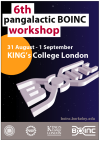 The 6th BOINC Workshop will be held 31 Aug - 1 Sept. in London.
22 Jul 2010, 18:28:26 UTC
· Discuss
London Citizen Cyberscience Summit
The London Citizen Cyberscience Summit on September 2-3 will be a chance for scientists and citizens to learn about the latest breakthroughs in citizen cyberscience. The event will feature speakers from a number of BOINC projects.
7 Jul 2010, 3:53:47 UTC
· Discuss
GPU example apps available
Sample BOINC applications for NVIDIA/CUDA, NVIDIO/OpenCL, and ATI Stream OpenCL, together with instructions for building on Windows, Linux, and Mac OS X, are now available. Thanks to Tuan Le for developing these.
6 Jul 2010, 19:45:16 UTC
· Discuss
Campus Party kick-off event streaming video
A speech (in Spanish) launching the Campus Party / Rosetta@home campaign will broadcast by streaming video on Thursday 1 July at 19:00 GMT-5 (Channel 5).
30 Jun 2010, 17:35:14 UTC
· Discuss
CPDN scientist wins award
Myles Allen, director of Climateprediction.net, has won the 2010 Appleton Prize, which rewards distinguished research in environmental, earth or atmospheric physics.
29 Jun 2010, 21:55:02 UTC
· Discuss
Campus Party Colombia to boost Rosetta@home
Campus Party Colombia plans a promotion of Rosetta@home. (Spanish, English)
16 Jun 2010, 23:28:43 UTC
· Discuss
Video on MalariaControl.net
Check out a video on the use of volunteer computing to fight malaria (2 minutes, available in Spanish and English).
31 May 2010, 22:18:49 UTC
· Discuss
New version of BoincTasks available
A new version of BoincTasks, with multi-language support, is available. BoincTasks is a GUI application for Windows that lets you monitor and control up to 300 BOINC clients from a single window.
25 May 2010, 21:27:10 UTC
· Discuss
BOINC 6.10.56 released
The next version of BOINC is now ready for public use. Check the release notes and version history for details.
24 May 2010, 20:08:58 UTC
· Discuss
BOINC project name service
New or experimental BOINC-based projects without a domain name can now get a name of the form http://myproject.boincproject.com/. Thanks to Willy de Zutter of BOINCStats.com for offering this service.
24 May 2010, 18:26:35 UTC
· Discuss
BOINC simulator released at Univ. of Delaware
EmBOINC, a simulator for studying scheduling policies in large volunteer computing projects, is available for use by researchers.
24 May 2010, 17:52:13 UTC
· Discuss
AQUA@home deploys first OpenCL application on BOINC
Congratulations to the AQUA@home project, which has deployed the first OpenCL application on BOINC. OpenCL is a new programming system for GPUs and multicore CPUs.
17 May 2010, 16:07:34 UTC
· Discuss
Interview on www.seti.cl (Spanish)
David Anderson, director of BOINC and SETI@home, is interviewed on www.seti.cl (in Spanish).
11 May 2010, 22:24:12 UTC
· Discuss
German WW II message cracked by Enigma@home
The Enigma@Home project has decrypted one of 22 previously unbroken German Army messages encrypted with the Enigma machine.
11 May 2010, 4:12:51 UTC
· Discuss
BOINC 6.10.43/44 withdrawn
Due to a bug in .43/.44, the currently stable BOINC client has been rolled back to 6.10.18. The bug in question only affects volunteers using GPUs that do not have enough GPU RAM to execute their desired project applications. This bug is fixed in 6.10.46 or newer.
29 Apr 2010, 20:50:51 UTC
· Discuss
Article in Fast Company
Fast Company magazine has an article on IBM World Community Grid.
21 Apr 2010, 19:58:18 UTC
· Discuss
BOINC web site now available in Finnish
A Finnish translation of the BOINC web site is now available, thanks to Sami Nordlund.
8 Apr 2010, 18:06:03 UTC
· Discuss
BOINC 6.10.43/44 released
A new version of the client software is available for download
5 Apr 2010, 18:32:46 UTC
· Discuss
New BOINC/Ubuntu ISO image available
Version 1.2 of Dotsch/UX, an ISO-format Ubuntu image with the 6.10.17 client, for USB, diskless, and CD-ROM install, is available for download.
31 Mar 2010, 23:53:24 UTC
· Discuss
Support for Mac OS 10.6.3
Mac users, if you upgrade to OS 10.6.3, 2 issues may arise:
- The upgrade may delete your login item for BOINC Manager. If this happens, BOINC will not launch automatically when you log in or restart your Mac. Just run the BOINC installer again to fix this.
- If you are running CUDA tasks, you must upgrade to version 3.0 of the CUDA drivers, which you can download here.
29 Mar 2010, 22:34:55 UTC
· Discuss
Article on volunteer computing
Check out Volunteer Computing Needs You, an article in Computer Power User magazine.
18 Mar 2010, 4:20:55 UTC
· Discuss
Article on Einstein@OSG
An article in iSGTW discusses the use of Grid resources by Einstein@home.
17 Mar 2010, 22:45:17 UTC
· Discuss
QCN article
An article about Quake Catcher Network recently appeared in the Los Angeles Times.
16 Mar 2010, 21:30:57 UTC
· Discuss
Almere Desktop Grid event
The 3rd AlmereGrid Grid Experience workshop, and the EDGeS@Home launch event, will take place March 29/30, 2010 in Almere, The Netherlands.
9 Mar 2010, 23:50:04 UTC
· Discuss
Italian citizen science site
Check out Calcolo Distribuito, an Italian-language web site about volunteer computing and other public-participation science.
8 Mar 2010, 4:16:14 UTC
· Discuss
New project: QuantumFIRE alpha
QuantumFIRE alpha is a test project for QuantumFIRE, which will be dedicated to research into Quantum Foundations and Solid State Physics. The project is based at the Cavendish Laboratory, University of Cambridge.
5 Mar 2010, 21:33:30 UTC
· Discuss
German BOINC glossary released
The crunchers@freiburg team has released a German glossary of BOINC terms.
2 Mar 2010, 5:20:28 UTC
· Discuss
Boinc.NET released
Boinc.NET, a 3rd-party BOINC GUI for Windows based on .NET 3.5, has been released. It lets you manage multiple clients from one place.
19 Feb 2010, 22:37:36 UTC
· Discuss
Motivation study published
An study of cybervolunteer motivation by Viola Krebs has been published in FirstMonday.org, a journal devoted to Internet studies.
11 Feb 2010, 5:07:58 UTC
· Discuss
BOINC supports GPU computing on Mac OS X
GPU-based volunteer computing is now available on the Macintosh! Mac owners with NVIDIA GPUs can run GPU-enabled applications from Einstein@home and Collatz Conjecture. You'll need the latest development version of BOINC (6.10.28) and NVIDIA's CUDA driver.
13 Jan 2010, 21:04:50 UTC
· Discuss
P-GRADE Portal supports BOINC
The P-GRADE Grid Portal developed by the SZTAKI Institute in Hungary now supports BOINC as a computational back end.
7 Jan 2010, 23:40:55 UTC
· Discuss
An article on volunteer computing appeared today in the Argentine newspaper La Nacion.
27 Nov 2009, 0:00:00 UTC
· Discuss
The Fifth BOINC Workshop was held Oct. 22-23 in Barcelona. There were 35 attendees and 21 excellent talks; many of the presentation slides and discussion notes are online.
30 Oct 2009, 0:00:00 UTC
· Discuss
Version 6.10 of the BOINC client software has been released for general use. Download it here.
30 Oct 2009, 0:00:00 UTC
· Discuss
The Windows versions of 6.6.41 have been recalled due to a version mismatch with recent Microsoft updates. Please use the 6.6.38 version until 6.10 is released.
28 Oct 2009, 0:00:00 UTC
· Discuss
An article in the Wall Street Journal discusses the use of volunteer computing in medical research.
21 Oct 2009, 0:00:00 UTC
· Discuss
Welcome to NFS@home, a new project from California State University Fullerton. NFS@Home uses volunteer computing to do the lattice sieving step in the Number Field Sieve factorization of large integers.
12 Oct 2009, 0:00:00 UTC
· Discuss
BoincTasks, a new visual interface to BOINC, has been released for Windows. BoincTasks lets you manage a single computer locally, or all your computers remotely.
4 Oct 2009, 0:00:00 UTC
· Discuss
An article in the NY Times describes a project using BOINC to simulate the development of life at the molecular level.
1 Oct 2009, 0:00:00 UTC
· Discuss
The Brazilian TV networks Globonews and Futura recently broadcast a report on IBM World Community Grid (in Portuguese).
21 Sep 2009, 0:00:00 UTC
· Discuss
An article in PCWorld, 12 Worthy Causes Seek Your Spare PC Cycles, describes BOINC and 12 projects that use it.
4 Sep 2009, 0:00:00 UTC
· Discuss
Facebook users: check out the BOINC Milestones app.
3 Sep 2009, 0:00:00 UTC
· Discuss
UNITAR, UNIGE and CERN have agreed to collaborate on a Citizen Cyberscience Centre which, among other things, will promote volunteer computing.
24 Aug 2009, 0:00:00 UTC
· Discuss
The EDGeS project is offering a tutorial on using BOINC for desktop grid computing on 20 Sept 2009 in Barcelona.
19 Aug 2009, 0:00:00 UTC
· Discuss
Check out an article in The Sydney Morning Herald about volunteer computing in Australia.
18 Aug 2009, 0:00:00 UTC
· Discuss
Intel (in partnership with GridRepublic and BOINC) announces Progress Thru Processors, a Facebook application that makes participating in BOINC simpler and more sociable.
3 Aug 2009, 0:00:00 UTC
· Discuss
Videos of the talks at the recent Asia@home workshop in Taiwan are now online.
30 Jul 2009, 0:00:00 UTC
· Discuss
Listen to a Podcast of an interview with David Anderson on RCE.
20 Jul 2009, 0:00:00 UTC
· Discuss
The Consejeria de Educacion, Spain, is using Jarifa to harness the power of 12,000 PCs
The Consejeria de Educacion, Spain, is using Jarifa to harness the power of 12,000 PCs.
15 Jul 2009, 0:00:00 UTC
· Discuss
Read an article about Docking@Home in Newswise Science News.
23 Jun 2009, 0:00:00 UTC
· Discuss
Check out BOINC! How your computer can benefit all of mankind, a story in the online Dish Magazine.
10 Jun 2009, 0:00:00 UTC
· Discuss
ICVolunteers is conducting an online poll to study motivation in volunteer computing. Volunteers are encouraged to complete this poll.
5 Jun 2009, 0:00:00 UTC
· Discuss
Mac users: check out BOINCMenubar 2, an alternative to the BOINC Manager for Mac OS X.
1 Jun 2009, 0:00:00 UTC
· Discuss
Check out Citizen Scientists, a podcast by the 365 Days of Astronomy project.
17 May 2009, 0:00:00 UTC
· Discuss
Planet BOINC is a new RSS feed that combines many different sources of news about BOINC and volunteer computing.
14 May 2009, 0:00:00 UTC
· Discuss
Francois Grey talks about citizen cyber-science at TEDx Warwick.
14 May 2009, 0:00:00 UTC
· Discuss
See a video (in Spanish with English subtitles) about Extremadura@home and volunteer computing.
13 May 2009, 0:00:00 UTC
· Discuss
An article in EMBO reports discusses citizen cyber-science.
12 May 2009, 0:00:00 UTC
· Discuss
Simon Lin of Academia Sinica discusses volunteer computing (and thinking) in Asia on a Podcast on BBC World Service.
1 May 2009, 0:00:00 UTC
· Discuss
An article in Cornell's Chronicle Online discusses a new application in Einstein@home that searches for pulsars in binary star systems.
29 Apr 2009, 0:00:00 UTC
· Discuss
Francois Grey discusses Citizen Cyberscience (and BOINC) in The CERN Courier.
29 Apr 2009, 0:00:00 UTC
· Discuss
A workshop on volunteer computing with BOINC was held in Taipei on 16-17 April. Lecture outlines and slides are available online.
21 Apr 2009, 0:00:00 UTC
· Discuss
BOINC 6.6 has been released to public for Windows and MacOS X. Please visit the download page and upgrade today.
9 Apr 2009, 0:00:00 UTC
· Discuss
Check out a new French-language web site about volunteer computing.
6 Apr 2009, 0:00:00 UTC
· Discuss
VTU@home, a project from the Vilnius Gediminas Technical University, is now listed on the Choose Projects page. VTU@home serves Lithuanian scientists. It is currently studying the automated testing of complex software systems.
30 Mar 2009, 0:00:00 UTC
· Discuss
Volunteer computing goes East - a story on upcoming events in Taiwan and Beijing - appears in International Science Grid This Week.
18 Mar 2009, 0:00:00 UTC
· Discuss
A new add-on for Windows, BOINCcalculator, shows details (trickles, credit, timesteps, checkpoints) of running CPDN jobs.
9 Mar 2009, 0:00:00 UTC
· Discuss
Cosmology@Home, a project from the University of Illinois whose goal is to search for the model that best describes our Universe, is now listed on the Choose Projects page.
9 Mar 2009, 0:00:00 UTC
· Discuss
BOINC was the subject of a 40-minute radio program (in Polish) on Tok FM (click on 'O sile polaczonych komputerow').
5 Mar 2009, 0:00:00 UTC
· Discuss
We have released BOINC 6.4.7 for Windows. This release contains a screensaver fix as well as updates to LibCurl(7.19.4) and OpenSSL(0.9.8j) for some recently published security advisories.
3 Mar 2009, 0:00:00 UTC
· Discuss
United BOINC now offers signature images containing the latest news from your choice of projects.
1 Mar 2009, 0:00:00 UTC
· Discuss
We have rolled back to 6.4.5 for our latest stable version until 6.4.7 can be built. Something happened to 6.4.6 on our mirrors.
27 Feb 2009, 0:00:00 UTC
· Discuss
A new add-on program for Windows, TThrottle, throttles CPU usage to keep its temperature below a limit you select.
17 Feb 2009, 0:00:00 UTC
· Discuss
A workshop on volunteer computing will take place 16-17 April 2009 at the Academia Sinica in Taipei, Taiwan, in conjunction with the International Symposium on Grid Computing.
13 Feb 2009, 0:00:00 UTC
· Discuss
Congratulations to SETIBR, the Brazilian team which, across several BOINC-based projects, has achieved the levels of 100K average credit and 50M total credit.
3 Feb 2009, 0:00:00 UTC
· Discuss
Scientists: it's easier than ever to create a BOINC project - you don't even need a server! Instead, you can use the Amazon Elastic Computing Cloud, with a virtual machine image created by Derrick Kondo of INRIA.
29 Jan 2009, 0:00:00 UTC
· Discuss
Extremadura@home is a new kind of account manager in which the choice of projects is a group decision. It's targeted at Spanish computer owners but is open to everyone.
28 Jan 2009, 0:00:00 UTC
· Discuss
Dotsch/UX is an ISO-format Linux distribution, based on Ubuntu Linux, with the 6.2.15 BOINC client pre-installed. It lets you easily install and boot from a USB stick, hard disk and from diskless clients, and it also has some interfaces to set up the diskless server and the clients automatically. Download info is here.
27 Jan 2009, 0:00:00 UTC
· Discuss
A paper about Quake-Catcher Network appeared in Seismological Research Letters, Jan/Feb 2009.
22 Jan 2009, 0:00:00 UTC
· Discuss
A paper about BOINC, "Celebrating Diversity in Volunteer Computing", has won a Best Paper award at the 42nd Hawaii International Conference on System Sciences.
20 Jan 2009, 0:00:00 UTC
· Discuss
The Docking@home project has a spiffy new web site, and welcomes new volunteers.
14 Jan 2009, 0:00:00 UTC
· Discuss
An article about AQUA@home appeared in today's New York Times online.
22 Dec 2008, 0:00:00 UTC
· Discuss
BOINC now supports computing using NVIDIA GPUs. Two projects currently have GPU-enabled applications: GPUgrid.net and SETI@home. If your computer has a recent NVIDIA GPU, you can compute 2X to 10X faster than with your CPU alone.
17 Dec 2008, 0:00:00 UTC
· Discuss
A press release from NVIDIA announcing BOINC's GPU support is available in English, Spanish, and Catalan.
17 Dec 2008, 0:00:00 UTC
· Discuss
Version 6.4 of the BOINC client software has been released. This is the recommended version for Windows and Linux. Upgrade now.
16 Dec 2008, 0:00:00 UTC
· Discuss
AQUA@home is now open to volunteers. AQUA (Adiabatic QUantum Algorithms) is a research project, based at D-Wave Systems, Inc., whose goal is to predict the performance of superconducting adiabatic quantum computers on a variety of hard problems arising in fields ranging from materials science to machine learning.
10 Dec 2008, 0:00:00 UTC
· Discuss
IBM World Community Grid and Harvard launch an application to study a new type of photovoltaic solar cells.
8 Dec 2008, 0:00:00 UTC
· Discuss
Wikipedia'a featured article for today is about Rosetta@home.
1 Dec 2008, 0:00:00 UTC
· Discuss
Check out BOINC.Italy, a new Italian BOINC portal.
29 Nov 2008, 0:00:00 UTC
· Discuss
Rechenkraft.net is petitioning the German government to use non-security sensitive institutional computers to assist scientific research.
29 Nov 2008, 0:00:00 UTC
· Discuss
See a video celebrating the fourth anniversary of IBM World Community Grid.
20 Nov 2008, 0:00:00 UTC
· Discuss
Jarifa, a system for organizational grid computing using BOINC, has a new name, logo, and domain.
20 Nov 2008, 0:00:00 UTC
· Discuss
On 27-28 November 2008, AlmereGrid and EDGeS will organise a two-day Desktop Grid workshop in Almere, The Netherlands.
7 Nov 2008, 0:00:00 UTC
· Discuss
Read Reaching for the Exa-scale with volunteer computing in International Science Grid This Week.
17 Oct 2008, 0:00:00 UTC
· Discuss
An article on the recent BOINC workshop in Grenoble appeared in International Science Grid This Week.
30 Sep 2008, 0:00:00 UTC
· Discuss
An article on PS3grid.net project, which does scientific computing on Sony Playstations, appeared recently in Science.
29 Sep 2008, 0:00:00 UTC
· Discuss
See an open letter to the Electronic Frontier Foundation.
27 Sep 2008, 0:00:00 UTC
· Discuss
Read an article about Quake Catcher Network in Economist.com.
25 Sep 2008, 0:00:00 UTC
· Discuss
Ibercivis, a joint project of several Spanish universities and research institutes, is now open to the public. Sign up and support Spanish research.
25 Sep 2008, 0:00:00 UTC
· Discuss
Welcome back to Docking@Home, a project at the University of Delaware that studies protein-ligand interactions (and BOINC itself).
20 Sep 2008, 0:00:00 UTC
· Discuss
OGM (Organizational Grid Manager) has been released by the University of Extremadura. OGM is a system for grid computing on organizational resources using BOINC.
15 Sep 2008, 0:00:00 UTC
· Discuss
The talks and tutorials from the upcoming BOINC Workshop (Sept 10-12) will be broadcast live on the Web.
4 Sep 2008, 0:00:00 UTC
· Discuss
BOINC is featured on the University of Delaware news site.
4 Sep 2008, 0:00:00 UTC
· Discuss
Welcome to the NQueens@home project, from the Universidad de Concepción in Chile, which seeks to find the solutions to the N Queens problem for values of 26 and greater.
26 Aug 2008, 0:00:00 UTC
· Discuss
LinkedIn users: join a BOINC Users group.
19 Aug 2008, 0:00:00 UTC
· Discuss
BOINC 6.2 is now the recommended version for all platforms. Upgrade now.
30 Jul 2008, 0:00:00 UTC
· Discuss
The Quake Catcher Network detected today's magnitude 5.4 earthquake in Los Angeles within 7 seconds.
29 Jul 2008, 0:00:00 UTC
· Discuss
The First East Coast BOINC Meeting will take place August 29 2008 at the University of Delaware.
24 Jul 2008, 0:00:00 UTC
· Discuss
GPU computing has arrived to BOINC! The GPUGRID.net project from the Barcelona Biomedical Research Park (PRBB) uses CUDA-capable NVIDIA chips to create an infrastructure for biomolecular simulations. (Currently available for Linux64; other platforms to follow soon. To participate, follow the instructions on the web site).
17 Jul 2008, 0:00:00 UTC
· Discuss
BOINC-logo merchandise (T-shirts, mouse pads) is now available.
10 Jul 2008, 0:00:00 UTC
· Discuss
New add-on software: phpBOINCer, a PHP script to display BOINC stats on a webpage, and store or retrieve these stats to a mySQL database.
9 Jul 2008, 0:00:00 UTC
· Discuss
3-D versions of the BOINC logo are now available; thanks to John from Ireland for creating these.
16 Jun 2008, 0:00:00 UTC
· Discuss
BOINCstats and BAM! are now available in Brazilian Portuguese and Turkish.
2 Jun 2008, 0:00:00 UTC
· Discuss
The Orbit@home project from the Planetary Science Institute is open for public beta test. Orbit@home focuses on celestial mechanics, Their first scientific application, SurveySimulator, simulates the performance of astronomical surveys searching for Near Earth Objects (NEOs) such as asteroids and comets.
31 May 2008, 0:00:00 UTC
· Discuss
The source code for BOINCoid (a port of BOINC to Java and to Google's Android platform, by computer scientists from Technion) has been released on Sourceforge.net.
18 May 2008, 0:00:00 UTC
· Discuss
BOINC volunteer Werner Klein is interviewed in Sternengucker.org (German).
9 May 2008, 0:00:00 UTC
· Discuss
The BOINC FAQ Service is now available in Spanish and French (as well as English, German, and Dutch).
9 May 2008, 0:00:00 UTC
· Discuss
CASP8 starts soon
CASP8, a competition for protein structure prediction, starts soon. Rechenkraft.net is sponsoring a team credit-race to support POEM@home, one of the CASP participants. Results will be reported at Planet BOINC.
7 May 2008, 0:00:00 UTC
· Discuss
Alpha testing of BOINC software is done by volunteers. Many thanks to this month's top testers.
6 May 2008, 0:00:00 UTC
· Discuss
Version 3.0 of Boinc LCS (a free PHP script for monitoring remote BOINC clients) has been released.
5 May 2008, 0:00:00 UTC
· Discuss
The BOINC user documentation has been moved from Trac to Mediawiki, which provides better navigation and editing interfaces. Please help us fix the remaining broken links.
20 Apr 2008, 0:00:00 UTC
· Discuss
Congratulations to NEZ, whose contribution to BOINC-based projects recently exceeded 10 TeraFLOPS. This would (and should) rank 136th on the Top 500 Supercomputer list.
7 Apr 2008, 0:00:00 UTC
· Discuss
The BOINC client software is now available for Fedora 7 and higher from official repositories. To install it, just type yum install boinc-client boinc-manager as root. Thanks to Milos Jakubicek, with help from Eric Myers and Debarshi Ray.
31 Mar 2008, 0:00:00 UTC
· Discuss
Read about a new BOINC-based project, Quake Catcher Network, in Wired and Nature News.
28 Mar 2008, 0:00:00 UTC
· Discuss
Watch an excellent talk by CERN's Francois Grey, From distributed computing to distributed thinking.
20 Mar 2008, 0:00:00 UTC
· Discuss
Read Volunteer Computing and the Search for Big Answers, an article about BOINC and volunteer computing on LinuxInsider.com.
5 Mar 2008, 0:00:00 UTC
· Discuss
Scientific progress goes BOINC! Read about the Scientific publications of BOINC-based projects.
27 Feb 2008, 0:00:00 UTC
· Discuss
Where is BOINC headed? Marcin Cieslak's vision: BOINC on JXTA.
12 Feb 2008, 0:00:00 UTC
· Discuss
Bulgarian BOINC users: find forums and information in your language at BOINC Bulgaria.
11 Feb 2008, 0:00:00 UTC
· Discuss
Proteins@Home has resumed operations
Proteins@Home has resumed operations. Check out their paper on computational protein design in the Journal of Computational Chemistry.
7 Feb 2008, 0:00:00 UTC
· Discuss
The TSP project is featured in International Science Grid This Week: Traveling salesman meets distributed computing.
31 Jan 2008, 0:00:00 UTC
· Discuss
BOINC has broken the PetaFLOP barrier! According to BOINCStats, 106 million units of credit were granted yesterday, which translates to 1.06 PetaFLOP/sec. Congratulations to all projects and participants.
31 Jan 2008, 0:00:00 UTC
· Discuss
A paper describing results of the Quantum Monte Carlo at Home project recently appeared in the Journal of Physical Chemistry A (JPCA).
24 Jan 2008, 0:00:00 UTC
· Discuss
A new article from the Planetary Society: From SETI@home to Hominid Fossils: Citizen Cyberscience Reshapes Research Landscape.
15 Jan 2008, 0:00:00 UTC
· Discuss
The cross-project statistics site All Project Stats.com has many improvements and new features, include credit-based signature images for users and teams.
14 Jan 2008, 0:00:00 UTC
· Discuss
A new competition for BOINC teams, Formula BOINC, is based on their position with projects (as in Formula 1 racing) rather than overall credit. This rewards teams that are diversified across many projects.
10 Jan 2008, 0:00:00 UTC
· Discuss
A story in the Chicago Tribune, "Bit by bit, home computers aid science", highlights Cosmology@home.
26 Dec 2007, 0:00:00 UTC
· Discuss
The Lattice Project, based at the University of Maryland Center for Bioinformatics and Computational Biology, is now open to volunteers. Lattice runs several applications, and supplies computing power to a number of Life Sciences researchers. Current areas of study include evolutionary relationships based on DNA sequence data; bacterial, plasmid, and virus protein sequences; and biological diversity in nature reserves.
18 Dec 2007, 0:00:00 UTC
· Discuss
Watch a YouTube video about the science behind Rosetta@home.
5 Dec 2007, 0:00:00 UTC
· Discuss
The TSP (Traveling Salesman Problem) project is using BOINC to find the shortest path between the capitals of the lower 48 states.
5 Dec 2007, 0:00:00 UTC
· Discuss
This web site, and the BOINC-Wide Teams site, will be down for about 18 hours starting at 3 PM PST, Dec 6.
3 Dec 2007, 0:00:00 UTC
· Discuss
Live in Washington DC? Get together with other BOINC users via Meetup (or create a Meetup in your own city).
28 Nov 2007, 0:00:00 UTC
· Discuss
Leiden Classical allows students (and the public) to submit particle-system simulation jobs, and is thus a resource for both education and research. The job-submission system used by Leiden Classical is now included in the BOINC source code distribution.
16 Nov 2007, 0:00:00 UTC
· Discuss
BOINC needs more volunteer programmers! If you're proficient in PHP and MySQL, C++ and WxWidgets, or C++ system programming, please read about how you can help.
2 Nov 2007, 0:00:00 UTC
· Discuss
The BOINC-based BBC Climate Change Experiment has won the prestigious Prix Europa award in the Internet category.
22 Oct 2007, 0:00:00 UTC
· Discuss
Conmunix has released version 3.0 beta of Boinc LCS (Live Client State), a PHP script that allows you to monitor the current state and other information from each of your BOINC clients.
21 Oct 2007, 0:00:00 UTC
· Discuss
BOINC user John Koulouris has written The Big BOINC! Projects and Chronology Page, a brief history of BOINC.
18 Oct 2007, 0:00:00 UTC
· Discuss
Congratulations to the UK BOINC Team, which today became the first UK-specific team to pass the 100 million combined credits mark.
17 Oct 2007, 0:00:00 UTC
· Discuss
An article in Nature, The shape of protein structures to come, discusses the goals and progress of the Rosetta@home project from the University of Washington.
17 Oct 2007, 0:00:00 UTC
· Discuss
LHC@home has moved from CERN to the University of London. Read about it here.
12 Oct 2007, 0:00:00 UTC
· Discuss
The National Science Foundation has awarded a three-year grant, NSF award #OCI-0721124, to the BOINC project. This will support our development efforts through August 2010.
4 Oct 2007, 0:00:00 UTC
· Discuss
The Third Pan-Galactic BOINC Workshop took place 5-6 Sept. in Geneva. The proceedings, including talk slides and notes from the breakout sessions, are here.
26 Sep 2007, 0:00:00 UTC
· Discuss
Check out the SHA-1 Collision Search Graz project, which is based at the Graz University of Technology and does research in cryptography.
25 Sep 2007, 0:00:00 UTC
· Discuss
Team founders: you can now make your team BOINC-wide, meaning that it will be created on all current and future BOINC projects.
24 Sep 2007, 0:00:00 UTC
· Discuss
A one-day session on BOINC will be presented at the Advanced Computing and GRID technologies for Research school in Hanoi, November 5-16, 2007.
24 Sep 2007, 0:00:00 UTC
· Discuss
A paper about scheduling in BOINC will appear in the 3rd IEEE International Conference on e-Science and Grid Computing. Banagalore, India, December 10-13 2007.
21 Sep 2007, 0:00:00 UTC
· Discuss
The new BOINC logo is now available in a variety of formats and resolutions.
7 Sep 2007, 0:00:00 UTC
· Discuss
World Community Grid has announced that it is migrating fully to BOINC. Welcome to all WCG participants!
17 Aug 2007, 0:00:00 UTC
· Discuss
BOINC finally has a new logo! Many thanks Michal Krakowiak, the graphic designer who created it. The logo (and icons based on it) will soon appear on the BOINC client software as well as the web site.
25 Jul 2007, 0:00:00 UTC
· Discuss
 The Africa@home workshop on volunteer computing with BOINC, sponsored by the Geneva International Academic Network (GIAN), was held recently at the African Institute for Mathematical Sciences in Muizenberg, South Africa.
23 Jul 2007, 0:00:00 UTC
· Discuss
A newly-launched project, Eternity2.net, offers a chance to compute for a share of a US$2,000,000 prize.
20 Jul 2007, 0:00:00 UTC
· Discuss
Team leaders: check out the BOINC Team Leaders Forum, a place to chat and discuss team-building on BOINC projects.
20 Jul 2007, 0:00:00 UTC
· Discuss
If you use the Yahoo! Widget Engine, check out version 1.1 of the BOINC Server Status widget.
16 Jul 2007, 0:00:00 UTC
· Discuss
BOINC is now the preferred client software at World Community Grid.
16 Jul 2007, 0:00:00 UTC
· Discuss
Leiden Classical is using BOINC for education - it provides a high-performance computing resource for students of Theoretical Chemistry at Leiden University.
12 Jul 2007, 0:00:00 UTC
· Discuss
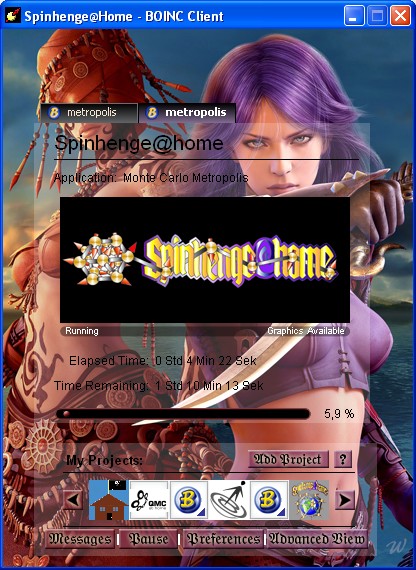 A growing number of 'skins' for the BOINC simple GUI are available from crunching-family.at. Here's an example.
10 Jul 2007, 0:00:00 UTC
· Discuss
Welcome to a new web site with cross-project BOINC statistics: Team Starfire World BOINC Stats 'N Stones.
6 Jul 2007, 0:00:00 UTC
· Discuss
Docking@home is moving from Texas to Delaware. Volunteers should detach from the project; you will be emailed when the project is alive in Delaware.
4 Jul 2007, 0:00:00 UTC
· Discuss
Read Volunteer computing: Grid or not Grid? on International Science Grid This Week.
2 Jul 2007, 0:00:00 UTC
· Discuss
Amir Alexander of The Planetary Society talks about SETI, distributed computing, and space exploration in an interview by Mike of BOINC UK.
2 Jul 2007, 0:00:00 UTC
· Discuss
Linux users: if you use bash, check out a cool script that provides command completion in both boinc_cmd and boinc_client (thanks to Frank S. Thomas).
28 Jun 2007, 0:00:00 UTC
· Discuss
Help increase volunteer computing power - publicize BOINC by writing to computer magazines.
27 Jun 2007, 0:00:00 UTC
· Discuss
There's a great new statistics site, BOINC All Project Stats. It has lists of the top users and teams, recent changes in rankings, graphs showing history and breakdown by project, and many other features. You can also see the stats and rankings of an individual volunteer or team across all BOINC projects. Thanks to Markus Tervooren for putting this together!
26 Jun 2007, 0:00:00 UTC
· Discuss
There are reports that version 5.10.8 of the BOINC client software causes a problem on Windows XP Pro in which the desktop becomes empty. If you see this, please uninstall 5.10.8 and install version 5.8.16.
26 Jun 2007, 0:00:00 UTC
· Discuss
BOINCstats and BAM! are now viewable in Finnish (http://fi.boincstats.com).
3 Jun 2007, 0:00:00 UTC
· Discuss
Sony Playstation 3 owners: researchers at the Barcelona Biomedical Research Park have launched PS3GRID, a BOINC-based project whose application (molecular dynamics simulations) runs on the PS3's Cell processor, on Linux.
31 May 2007, 0:00:00 UTC
· Discuss
Check out a video promoting BOINC on YouTube.[/url]
29 May 2007, 0:00:00 UTC
· Discuss
A Flash guide to using BOINC with IBM World Community Grid is available in Czech and English.
28 May 2007, 0:00:00 UTC
· Discuss
The 3rd Pan-Galactic BOINC Workshop will be held 5-6 September 2007 in Geneva, Switzerland.
14 May 2007, 0:00:00 UTC
· Discuss
The BOINC Virtual Server - a VMWare virtual machine preconfigured with BOINC and all prerequisite software - is now available. This greatly simplifies the task of creating a BOINC projects. Thanks to Christian Beer for creating this.
9 May 2007, 0:00:00 UTC
· Discuss
As of about May 1, BOINC projects have had over one million volunteers.
8 May 2007, 0:00:00 UTC
· Discuss
An excellent article on BOINC and the projects using it appeared today in the Catalan newspaper AVUI. It is available in PDF (pages one and two) and also as a web page. Thanks to Dr. Jordi Portell i de Mora for telling us about it.
6 May 2007, 0:00:00 UTC
· Discuss
BOINCstats and BAM! are now available in 15 languages. As of today, they are now viewable in Swedish ( http://se.boincstats.com).
6 May 2007, 0:00:00 UTC
· Discuss
The source code behind BOINC Combined Stats is now available via Subversion. This may be helpful for other statistics site developers.
3 May 2007, 0:00:00 UTC
· Discuss
GridRepublic announces a significant upgrade to their web site, including improved registration workflow and better integration with IBM World Community Grid (including WCG sub-project registration).
24 Apr 2007, 0:00:00 UTC
· Discuss
Krystof Dolezal's Flash-based BOINC tutorials are now available in English and Slovak, as well as Czech.
23 Apr 2007, 0:00:00 UTC
· Discuss
BOINCstats and BAM! are now available in the Czech language (http://cz.boincstats.com). Thanks to Zelvuska for the translation.
23 Apr 2007, 0:00:00 UTC
· Discuss
Desktopgrid.hu has been created by the Computer and Automation Research Institute (SZATAKI) of the Hungarian Academy of Sciences (MTA). It provides information (and software downloads) for using BOINC for desktop Grid computing.
17 Apr 2007, 0:00:00 UTC
· Discuss
BOINC is now using Trac, an integrated software project management system. In particular: 1) the BOINC source code repository now uses Subversion; 2) the BOINC bug database has been moved to Trac; 3) documentation will be moved to a Wiki. See the BOINC/Trac page.
16 Apr 2007, 0:00:00 UTC
· Discuss
The BBC documentary 'Meltdown', which highlights Climateprediction.net, has been nominated for a British Academy of Film and Television Arts academy award.
11 Apr 2007, 0:00:00 UTC
· Discuss
Dr. Anderson gave the keynote talk, Volunteer Computing: Planting the Flag, at the PCGrid 2007 workshop, held at the IPDPS conference in Long Beach on March 30.
4 Apr 2007, 0:00:00 UTC
· Discuss
If you can read Czech, czech out some excellent Flash-based BOINC tutorials.
29 Mar 2007, 0:00:00 UTC
· Discuss
Africa@home (with support from the Geneva International Academic Network) is sponsoring an intensive one-week workshop on volunteer computing for qualified African students, to be held at the African Institute for Mathematical Sciences in Muizenberg, South Africa, 16-22 July 2007.
23 Mar 2007, 0:00:00 UTC
· Discuss
 Don't use them for postage, but check out the BOINC stamps created by Myster65 and Rebirther.
9 Mar 2007, 0:00:00 UTC
· Discuss
The article Idle Cycles - building distributed applications with BOINC Seil appears in the Oct 2006 issue of Linux Magazine. In it, author Marc Seil provides a detailed description of how to set up a BOINC project.
6 Mar 2007, 0:00:00 UTC
· Discuss
With BOINCpe you can run a dedicated BOINC machine using a RAM disk, starting from only 256 MB of total RAM. This lets you operate a BOINC farm more energy-efficiently or to use machines without hard disk drives for BOINC.
1 Mar 2007, 0:00:00 UTC
· Discuss
The BOINC web server recently underwent a hardware and software upgrade. Certain projects and pages may still be offline as we continue to configure the new system.
28 Feb 2007, 0:00:00 UTC
· Discuss
Marc Seil gave a talk on setting up a BOINC server at the recent LinuxDays conference in Luxembourg. His slides are here.
8 Feb 2007, 0:00:00 UTC
· Discuss
GridRepublic has been selected as a finalist for the Web Awards at the 2007 SXSW Interactive Festival. Please click here to cast your vote for them at the SXSW website.
5 Feb 2007, 0:00:00 UTC
· Discuss
The documentation on Creating BOINC Projects is now available as one big PDF file.
3 Feb 2007, 0:00:00 UTC
· Discuss
The BOINC FAQ Service answers many questions about using BOINC. It is available in English, German, and Dutch.
24 Jan 2007, 0:00:00 UTC
· Discuss
Check out a TV news segment and a web site about the results of the recently-completed BBC Climate Change Experiment. On January 21 BBC aired a documentary on the results of this project; an excerpt is here.
19 Jan 2007, 0:00:00 UTC
· Discuss
The paper "Reporting@Home: Delivering Dynamic Graphical Feedback to Participants in Community Computing Projects" describes how Rosetta@home delivers personalized graphical progress reports to its volunteers.
18 Jan 2007, 0:00:00 UTC
· Discuss
Linux users: check out KBoincMgr, a replacement for the BOINC Manager. KBoincMgr can manage multiple BOINC clients, and has other features too numerous to mention.
17 Jan 2007, 0:00:00 UTC
· Discuss
On Sunday 21 Jan. at 8pm BBC 1 will broadcast Climate Change: Britain Under Threat. This will include results from the BBC and CPDN experiments, and an interview with CPDN staff. In addition, results should appear on the BBC Climate Change website.
17 Jan 2007, 0:00:00 UTC
· Discuss
The ABC@home project, based at Leiden University in Holland, is now open. ABC@home is studying the ABC conjecture, a major open problem in mathematics.
7 Jan 2007, 0:00:00 UTC
· Discuss
MySpace users: check out the BOINC on MySpace group.
6 Jan 2007, 0:00:00 UTC
· Discuss
A paper about BOINC client scheduling
A paper about BOINC client scheduling will appear in the Workshop on Large-Scale, Volatile Desktop Grids held in conjunction with the IEEE International Parallel & Distributed Processing Symposium (IPDPS), March 30, 2007, Long Beach.
29 Dec 2006, 0:00:00 UTC
· Discuss
The Proteins@Home project is now open
The Proteins@Home project is now open. Proteins@Home is a large-scale protein structure prediction project, and is based at the École Polytechnique in Paris.
28 Dec 2006, 0:00:00 UTC
· Discuss
Some AOL users are unable to attach to some projects. A work-around for this problem is described here.
21 Dec 2006, 0:00:00 UTC
· Discuss
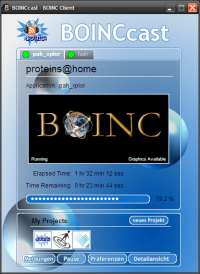 Olaf Bornack of Team BOINC@Halle/Saale has supplied stencils for creating skins for the new BOINC GUI. These have been used to make skins with BOINCcast, BOINC@Halle/Saale, and BOINCmas! themes.
8 Dec 2006, 0:00:00 UTC
· Discuss
Linux users: check out the new BOINCTail add-on.
6 Dec 2006, 0:00:00 UTC
· Discuss
BOINC's new Online Help system lets you get help from volunteers by talking with them using Skype. Volunteers speak several languages.
4 Dec 2006, 0:00:00 UTC
· Discuss
It hasn't been released yet, but already several skins are available for BOINC Manager version 5.8 (currently under test as version 5.7.x). Check out Crunching Family Skin Downloads.
4 Dec 2006, 0:00:00 UTC
· Discuss
A recent article in the Bulletin of the Howard Hughes Medical Institute, A Cast of Thousands, discusses the [url=http://boinc.bakerlab.org/rosetta/]Rosetta@home project and its army of dedicated volunteers.
4 Dec 2006, 0:00:00 UTC
· Discuss
Jean-Michel Penasse of L'Alliance Francophone has create a web site, www.myboinc.com, showing the User of the Day of all BOINC projects going back to October 8 2006. Check it out!
27 Nov 2006, 0:00:00 UTC
· Discuss
Docking@home participants: the project is unreachable because of a campus-wide network connection failure at Univ. of Texas - El Paso. Please check back periodically.
23 Nov 2006, 0:00:00 UTC
· Discuss
BOINCstats is now available in Spanish. Thanks to Miquel Pericas for the translation. BOINCstats in Spanish can be visited at http://es.boincstats.com.
15 Nov 2006, 0:00:00 UTC
· Discuss
Check out new add-on software: the SETI@home Toolbar for Firefox and IE on Windows (SETI@home-specific), and Boinctray, a system tray application for Linux.
7 Nov 2006, 0:00:00 UTC
· Discuss
We are preparing to release client software with a new GUI that is simpler, smaller, and more graphical than the current BOINC manager. Projects can supply their own graphics (icons, application-specific slideshows) for use in this GUI; see instructions for how to do this. In addition, the GUI itself is skinnable; a skin consists of an XML file and a collection of images.
7 Nov 2006, 0:00:00 UTC
· Discuss
Issue 3 of bunc (BOINC UK newsletter) is now online, with articles on a wide range of topics.
17 Oct 2006, 0:00:00 UTC
· Discuss
Interested in getting a one-CPU-month job finished in five minutes? BOINC can potentially help you do this, but some work is needed.
9 Oct 2006, 0:00:00 UTC
· Discuss
Versions of BOINC (and some applications) are now available for Solaris (x86, i686, SPARC), Linux (Alpha, SPARC), FreeBSD (x86, Alpha) and HPUX (including the BOINC Manager) from www.lb.shuttle.de.
8 Oct 2006, 0:00:00 UTC
· Discuss
Eric Korpela and David Anderson were interviewed today by Mike O'Connell of BOINC UK. Many topics were covered, including the question of credit and optimized clients. Download a recording of the conversation (MP3, 13.5 MB) from BOINC UK or a mirror at Berkeley.
4 Oct 2006, 0:00:00 UTC
· Discuss
The 2nd Annual Pangalactic BOINC Workshop was held in Geneva on 20-21 September. Read the online workshop proceedings.
26 Sep 2006, 0:00:00 UTC
· Discuss
UW-Madison CAE, the first BOINC user to top the 1 TERAFLOPS barrier, now has surpassed 2 TERAFLOPS. Congratulations!
11 Sep 2006, 0:00:00 UTC
· Discuss
The Spinhenge project has moved into public beta test, and is accepting new participant accounts.
2 Sep 2006, 0:00:00 UTC
· Discuss
GridRepublic, a BOINC account manager, recently moved into beta test. It was written up by CNET.
24 Aug 2006, 0:00:00 UTC
· Discuss
BOINC and SETI@home are featured in an article in Asahi-shinbun, one of the most popular newspapers in Japan.
20 Aug 2006, 0:00:00 UTC
· Discuss
New documents discuss using BOINC for Desktop Grid Computing and for creating Virtual Campus Supercomputing Centers.
16 Aug 2006, 0:00:00 UTC
· Discuss
A BBC Radio program on 'Citizen Science' - including a segment on volunteer computing and BOINC - will air tomorrow, 16 Aug 2006, 9 PM British Time. It will also be available online.
15 Aug 2006, 0:00:00 UTC
· Discuss
Participants with preferences for different venues (home, school, work) can now view these side-by-side in a multi-column format. Also, preference values are now checked for validity. Thanks to Christian Beer for the PHP programming behind these improvements.
14 Aug 2006, 0:00:00 UTC
· Discuss
An article about Quantum Monte Carlo at Home appeared 03.08.2006 in the German newspaper WAZ.
11 Aug 2006, 0:00:00 UTC
· Discuss
A recent update of McAfee security software on Windows causes BOINC 5.4.9 to not work (details). We have released a new version, 5.4.11, that fixes the problem and works with the latest McAfee software.
3 Aug 2006, 0:00:00 UTC
· Discuss
The 2nd Pan-Galactic BOINC Workshop will be held 20-21 September at the University of Geneva, Switzerland. Anyone actively involved with BOINC is encouraged to attend.
2 Aug 2006, 0:00:00 UTC
· Discuss
Chess960@home is open for testers. This project studies a game that is like classical chess except that the initial configuration of pieces is chosen randomly from among 960 possibilities.
26 Jul 2006, 0:00:00 UTC
· Discuss
Welcome to three new BOINC-based projects. Two are mathematical: Riesel Sieve looks for prime numbers of the form k2n-1, and Rectilinear Crossing Number studies a problem in computational geometry. The third, Spinhenge@home, studies molecular magnets and controlled nanoscale magnetism, which may have applications in medicine and biotechnology.
25 Jul 2006, 0:00:00 UTC
· Discuss
BOINC user survey: due to a bug in our software, answers to the question 'Which are the most important factors when you decide whether to participate in a BOINC project?' were not recorded correctly. Please fill out the survey form again. We apologize for the inconvenience.
22 Jul 2006, 0:00:00 UTC
· Discuss
The BOINC survey is now available in Japanese. If you'd like to translate it to another language, please contact us.
21 Jul 2006, 0:00:00 UTC
· Discuss
We are conducting an online survey of BOINC participants. Please fill out the survey form - your responses will help us improve BOINC and the projects that use it.
13 Jul 2006, 0:00:00 UTC
· Discuss
Articles in Nature, The Economist and WebWire describe Africa@home, an initiative that supports African humanitarian causes. Their first BOINC-based project, malariacontrol.net, studies malaria epidemiology. Africa@home is a collaboration of the Swiss Tropical Institute, CERN, and a group of universities (three of them from Africa).
13 Jul 2006, 0:00:00 UTC
· Discuss
The TANPAKU project, based at the Tokyo University of Science, is open for participation. TANPAKU (from the Japanese word tanpaku-shitsu, meaning 'protein') studies protein structure and function using a novel method called Brownian Dynamics.
7 Jul 2006, 0:00:00 UTC
· Discuss
Want to deploy BOINC quickly and easily on a Windows network? Read The Lazy Slug's Guide to easy deployment and maintenance of BOINC on your network.
30 Jun 2006, 0:00:00 UTC
· Discuss
A paper about BOINC's API and runtime system will appear in the SC06 conference.
29 Jun 2006, 0:00:00 UTC
· Discuss
A new Secure BOINC Client for the Macintosh is available for testing. This version limits BOINC applications' access to your system and data, thus protecting your computer from accidental or malicious damage or data theft.
28 Jun 2006, 0:00:00 UTC
· Discuss
Pav Lucistnik has developed boinc_curses, a Unix console-based program (like 'top') to monitor and control BOINC.
22 Jun 2006, 0:00:00 UTC
· Discuss
BOINCstats and the BAM! account manager are now available in Japanese.
21 Jun 2006, 0:00:00 UTC
· Discuss
BOINC's CPU scheduler has become smarter: it now waits until an application has checkpointed to preempt it and remove it from memory. This can save significant CPU time, especially on multiprocessors. Technical details are here. The new scheduler is in the development version of BOINC, and will appear in the 5.6 release. Volunteer developer John McLeod VII was the driving force behind the new scheduler.
15 Jun 2006, 0:00:00 UTC
· Discuss
We have added preliminary support for legacy applications that do not use the BOINC API (e.g. because their source code is not available). This feature will work with the next version (5.6) of the BOINC client software.
14 Jun 2006, 0:00:00 UTC
· Discuss
The BOINC UK Newsletter Circular (bunc) has released its June 2006 edition, featuring an interview with David Anderson.
10 Jun 2006, 0:00:00 UTC
· Discuss
Windows users: if BOINC applications are repeatedly crashing on your computer, it's possibly that you need to upgrade to the latest version of DirectX.
7 Jun 2006, 0:00:00 UTC
· Discuss
Recent newspaper articles on BOINC and Rosetta@home: Worldwide, 690,000 help computer effort and Medical researcher taps the power of home computing.
31 May 2006, 0:00:00 UTC
· Discuss
The BOINCStats Account Manager (BAM!) is now available for use. BAM! provides 'one-stop shopping' for finding and attaching to BOINC project; see the news item of May 11. Thanks to Willy de Zutter for developing BAM!.
30 May 2006, 0:00:00 UTC
· Discuss
BOINC has added preliminary support for 'low-latency' computing; e.g. delay bounds of minutes rather than days. This requires having clients contact the server frequently; we've added a mechanism that lets the server specify the connection interval. This will be available in the next release (5.6) of the client software. Projects that are interested in using this mechanism should contact us.
25 May 2006, 0:00:00 UTC
· Discuss
The costs of electricity, both monetary and environmental, are high. Be aware of the energy considerations associated with BOINC and volunteer computing.
17 May 2006, 0:00:00 UTC
· Discuss
Version 5.4 of the BOINC client software has been released. This version lets you use account managers - special web sites that let you browse BOINC projects, attach/detach, change resource share and settings, all with point-and-click simplicity. Account managers are also great if you have several computers - you make changes on the web site, and they take effect on all of your computers. A couple of excellent account managers are nearly ready for use; stay tuned for details.
11 May 2006, 0:00:00 UTC
· Discuss
The first-ever BOINC birthday cake appeared at the 7th SETI@home-Catalonia Meeting (and 1st BOINC-Catalonia Meeting), held in Girona last April 22nd. Also: BOINC.cat, a BOINC site in Catalan, has recently opened.
9 May 2006, 0:00:00 UTC
· Discuss
 The latest German BOINCcast discusses ClimatePrediction.net; earlier BOINCcasts cover SIMAP, LHC@home, and uFluids.
30 Apr 2006, 0:00:00 UTC
· Discuss
The CERN Courier's Computer Newsletter features an article on BOINC activities at CERN.
14 Apr 2006, 0:00:00 UTC
· Discuss
According to various statistics sites, over one million computers have now contributed processing power to BOINC projects. We're currently achieving a sustained processing rate of over 400 TeraFLOPS - the world's most powerful supercomputer by a wide margin. Congratulations and thanks to everyone!
13 Apr 2006, 0:00:00 UTC
· Discuss
We have developed an example application, together with project files and Makefiles for Windows, Mac, and Linux. The application demonstrates how to do checkpoint/restart and graphics. Projects can use this as a framework for building their own applications.
13 Apr 2006, 0:00:00 UTC
· Discuss
Thanks to the efforts of volunteers, BOINC is now officially part of the Debian Linux distribution. Packages for the BOINC core client and Manager are available for 13 different platforms (alpha, amd64, arm, hppa, i386, ia64, kfreebsd-i386, m68k, mips, mipsel, powerpc, s390 and sparc).
6 Apr 2006, 0:00:00 UTC
· Discuss
Windows users: new versions of Intellipoint and Intellitype are available from Microsoft. Upgrading to these may fix problems with the BOINC screensaver.
4 Apr 2006, 0:00:00 UTC
· Discuss
BOINCstats.com is one of several excellent web sites showing BOINC statistics. It's available in a number of languages, now including Chinese.
3 Apr 2006, 0:00:00 UTC
· Discuss
The Seasonal Attribution Project, a spin-off of Climateprediction.net, seeks to determine the extent to which extreme weather events are attributable to human-induced climate change. Its application is a high-resolution simulation of the world's climate, and is recommended only for computers with at least 1 GB of RAM, and a 2.4GHz Pentium or faster processor.
15 Mar 2006, 0:00:00 UTC
· Discuss
Tony/Knightrider/Chuggybus has created BOINC coinage. See the large and small versions. The Latin text means 'Berkeley open and shared resources'.
5 Mar 2006, 0:00:00 UTC
· Discuss
Quantum Monte Carlo at Home announces the public release of the first chemistry BOINC project.
Quantum Monte Carlo at Home announces the public release of the first chemistry BOINC project. This project, based at the University of Münster in Germany, studies the structure and reactivity of molecules using Quantum Chemistry, whose vastly complex equations require huge amounts of computing power.
3 Mar 2006, 0:00:00 UTC
· Discuss
A significant step has been made towards integrating BOINC and Grid software: beginning with Condor version 6.7.17, Condor can be configured to run BOINC when it has no other work to perform. This capability is described in the Condor manual.
24 Feb 2006, 0:00:00 UTC
· Discuss
BOINC announces its support for the Macintosh/Intel platform.
22 Feb 2006, 0:00:00 UTC
· Discuss
BOINCcast is the first German Podcast about BOINC. Weekly episodes of 5 minutes length will explain Distributed Computing and the Goals of BOINC to the German public, and will present and explain the projects that use BOINC.
19 Feb 2006, 0:00:00 UTC
· Discuss
View a video clip about the BBC Climate Change Experiment.
15 Feb 2006, 0:00:00 UTC
· Discuss
BOINC and Climateprediction.net have joined forces with the BBC to launch a new experiment -- a full simulation of climate change from 1920 to 2080. The experiment is described on a BBC television documentary Meltdown (BBC-4, February 20th, for UK BOINCers). Simplified client software is available at bbc.co.uk/climatechange. Experienced BOINCers can attach to http://bbc.cpdn.org (check out the new graphics!). Be warned that a 160-year climate simulation is a long workunit even by Climateprediction.net's extravagant standards. But if you have a fast machine and are prepared to give us first call on your CPU, just for the next couple of months, then you could see your results in a second BBC television programme scheduled for May.
14 Feb 2006, 0:00:00 UTC
· Discuss
The SZTAKI Desktop Grid is now in production. The project, based at the MTA-SZTAKI Laboratory of Parallel and Distributed Systems in Budapest, Hungary, is attempting to find all the generalized binary number systems (bases are matrices and digits are vectors) up to dimension 11.
8 Feb 2006, 0:00:00 UTC
· Discuss
The Similarity Matrix of Proteins (SIMAP) project is now in production. SIMAP, based at the Technical University of Munich, uses volunteer computers to calculate similarities between proteins. It provides a public database of the resulting data, which plays a key role in many bioinformatics research projects. SIMAP is the first German BOINC-based project.
6 Feb 2006, 0:00:00 UTC
· Discuss
A story about SETI@home's transition to BOINC appears in the Nature web site.
15 Dec 2005, 0:00:00 UTC
· Discuss
A new paper, The Computational and Storage Potential of Volunteer Computing, explores the limits of BOINC-based projects.
12 Dec 2005, 0:00:00 UTC
· Discuss
BOINC has a job opening for an experienced programmer (C++/Python/PHP/SQL/HTML). For more information go to http://jobs.berkeley.edu/. The job is number 003496, and is listed under Information Technology.
9 Dec 2005, 0:00:00 UTC
· Discuss
We have created a new email list, boinc_announce@ssl.berkeley.edu, for announcements of new versions of BOINC client software.
29 Nov 2005, 0:00:00 UTC
· Discuss
Check out A BOINC seminar by Juan Antonio Lopez Perez of CERN, presented at CIEMAT in Madrid, November 2005. Also available in a print version.
27 Nov 2005, 0:00:00 UTC
· Discuss
Aggregate credit data (user and host credit data summed over all BOINC projects) is now available in XML format. This data can be used for applications (like the 'Featured participant' above) that reflect overall contribution to BOINC project.
15 Nov 2005, 0:00:00 UTC
· Discuss
IBM's World Community Grid has launched a BOINC-based project (currenly Linux only).
1 Nov 2005, 0:00:00 UTC
· Discuss
David Anderson talks about BOINC and volunteer computing in a podcast at www.enterpriseleadership.org.
28 Oct 2005, 0:00:00 UTC
· Discuss
Version 5.2.2 of the BOINC client software has been released. It includes a simpler registration procedure, security enhancements, and numerous other improvements.
20 Oct 2005, 0:00:00 UTC
· Discuss
Rosetta@home, a BOINC-based project at the University of Washington, has launched and is seeking participants. Its goal is "..
Rosetta@home, a BOINC-based project at the University of Washington, has launched and is seeking participants. Its goal is "... to develop methods that accurately predict and design protein structures and complexes, an endeavor that may ultimately help researchers develop cures for human diseases."
25 Sep 2005, 0:00:00 UTC
· Discuss
High-Performance Task Distribution for Volunteer Computing, a paper about BOINC server performance, will appear in the e-Science 2005 conference in December.
23 Sep 2005, 0:00:00 UTC
· Discuss
Searching for Gravity @ Home[/url], an article about Einstein@home and BOINC, appears in the September 2005 issue of IEEE's The Institute.
A conversation with David Anderson in ACM Queue Magazine.
We are redesigning BOINC to use a user-supplied identifier and password instead of a system-supplied random key for identifying an account. Comments on the design are welcome.
BOINC is transitioning to use libcurl for HTTP operations. This will allow BOINC to use HTTPS (secure HTTP) for scheduler requests and file transfers.
Non-open-source code (RSAEuro and GLUT) has been removed from BOINC. OpenSSL's crypto library is used for encryption.
A group of students from Cornell have written Distributing Science, a very nice article about BOINC and some of the projects using it.
A paper by Jakob Pedersen and Christian Søttrup discusses the interoperation of the Grid and BOINC.
The First Pangalactic BOINC Workshop was held at CERN, bringing together people from ClimatePrediction.net, Einstein@home, CERN, and BOINC.
BOINC statistics sites continue to evolve. Check out Every Earthly Hour, developed by Hydnum Repandum
We have added new API calls that allow applications to do their own CPU benchmarking, or directly report their floating-point operation count. This will give more accurate credit numbers for applications that are optimized for specific architectures or that use non-CPU computing resources such as GPUs.
We've added two mechanisms that give better estimates of result completion time (and thus better scheduling and fewer missed deadlines): 1) we track the 'CPU efficiency': the average fraction of CPU time that BOINC apps receive while they're running (this can be less than one on systems that run compute-intensive tasks other than BOINC); 2) we dynamically maintain a per-project upper bound on the ratio of actual CPU time to predicted CPU time.
We've improved and simplified the CPU scheduling and work-fetch policies, using a detailed simulation of BOINC's weighted round-robin scheduling. When the simulator predicts that a deadline will be missed, the client switches to earliest-deadline-first scheduling. When the simulator predicts that fetching additional work will cause a deadline to be missed, it suspends work fetch.
Account management system are web sites that let participants sign up for multiple projects with just a few clicks (and no account keys). The BOINC manager (development version) now lets you select, change, or get updated account info from an account manager.
BOINC now works in Windows 'service' mode on computers with dialup connections and the 'confirm before connect' preference set. The connection confirmation and setup process has been moved to the BOINC manager, which (unlike a service) is able to do GUI activities.
Climateprediction.net is featured in an article in the journal of the Institute of Electrical Engineers.
Two Wiki-based BOINC informational sites have been launched recently: The Unofficial BOINC Wiki (in English) and Deutsche BOINC FAQ (in German). Because these sites are Wikis, participants can add and modify content.
BOINC is featured in The Berkeley Science Review.
Eric Myers and Charlie Fenton have written excellent documents on how to compile BOINC and BOINC applications on Windows, Linux, and Mac OS X.
BOINC and BOINC-based projects are discussed in the article 'Grassroots Computing' in the May 6 2005 issue of Science magazine.
LHC@home is a BOINC-based project being used to simulate the orbits of particles in CERN's Large Hadron Collider (LHC). Read about it in the CERN Bulletin.
As the number of BOINC-based projects has increased, a problem has emerged - if a computer is attached to lots of projects, it may have trouble finishing work in time. We are revising the BOINC client's CPU scheduling and work-fetch policies to address this issue.
Many BOINC applications have interactive graphics (e.g. you can zoom in/out using the mouse). For apps that use the latest BOINC API, you can interact even when in screensaver mode - just hold down the control key.
We finally have an installer and GUI for Mac OS X! It is available as a development version, and will become the standard version soon.
Volunteers have ported SETI@home and BOINC to a variety of platforms, including Solaris/x86-64, Linux/x86-64, Linux/PPC, HP-UX, and FreeBSD.
We released the BOINC Menubar, a user-friendly client software version for Macintosh OS X. It can be installed and run through a GUI interface - no Unix commands. We also released the Windows installer announced in the January 1 2005 news item. Both are available on the Download page.
The Einstein@home project was officially launched this morning. BOINC users are encouraged to participate in this project, which searches for spinning neutron stars (also called pulsars) using data from the LIGO and GEO gravitational wave detectors.
We've added a framework for web-site translations (both BOINC-supplied and project-specific parts). We are adding support for account management systems that simplify participation in multiple projects. Security enhancement: all application files are digitally signed.
BOINC source code is now distributed under the Lesser GNU Public License (LPGL).
BOINC-based projects projects now have 80,721 participants in 188 countries. Based on current credit statistics, together they supply 106 TeraFLOPS of computing power - far more than any conventional supercomputer.
BOINC's message board system supports moderation.
With help from the Einstein@home group, we have refined BOINC's locality scheduling mechanism, It can now interact with project-specific programs that generate work on demand, and that maintain a 'working set' of data files for which work is distributed.
The Windows version of BOINC can now be configured to run when a particular user is logged in, to run when any user is logged in, or run all the time (as a service) even when no users are logged in.
With considerable help from the Einstein@home group, we have application graphics working on all platforms, including Linux. To handle hosts without graphics libraries, we have developed a new architecture in which graphics code resides in a dynamically loaded library.
Added prioritization to work distribution.
We have created a new email list, boinc_cvs@ssl.berkeley.edu. A summary of each CVS checkin to the BOINC source tree will be posted to this list.
A technical paper about BOINC is here. This paper appeared in the 5th IEEE/ACM International Workshop on Grid Computing, November 8, 2004, Pittsburgh, USA.
We have developed a GUI for the core client. It's similar to the old Windows GUI but is implemented using wxWidgets so it runs on all platforms. It offers new features such as the ability to suspend/resume projects and results, and project-specific web links. It uses a socket-based GUI RPC mechanism, which makes it possible to develop other GUIs, including ones that control many hosts.
A new utility, db_purge, allows projects to flush old entries from the result and workunit tables, so that these tables have a bounded size.
We have developed a new Windows installer that lets you run BOINC as a service, and that is compatible with the Microsoft MSI framework.
The application graphics framework now works on all platforms, including Mac OS X.
The message-board system now supports self-moderation (i.e., 'ignore lists').
BOINC servers can now use read-only database replicas for increased throughput.
XML Schemas for the statistics data exported by BOINC projects is here, and graphical representations are here.
We have created an email list, boinc_opt@ssl.berkeley.edu, for people interested in porting and optimizing BOINC applications. Sign up here.
We are working on a new type of work distribution, called Locality scheduling, that sends work to hosts that already have the needed files.
The Lattice project from the University of Maryland is developing a Grid system that integrates Globus, BOINC, and several other software components.
The new project LHC@home announces its first beta test, initially restricted to 1000 users. Please sign up at lhcathome.cern.ch.
The Climateprediction.net project is now open to the public.
Users can choose whether applications should quit or suspend when they're not executing.
The core client now checks whether disk usage exceeds user-specified limits, and if so it deletes projects files in a way that respects project resource shares.
Large BOINC projects (like SETI@home) were getting on the order of a million files in upload/download directories. This caused OS performance problems. We fixed this by providing a two-level directory hierarchy for upload/download directories.
The Climateprediction.net project recently held an Open Day, describing its status and its plans to use BOINC.
We made the core/app interface more flexible and general, providing better support for applications that consist of separate controller, worker, and graphics programs. We also added mechanisms that prevent multiple applications from running in the same slot, and that cause applications to exit if the core client dies.
We changed the SQL queries used by the performance-critical server components, such as the transitioner and feeder, to boost maximum server throughput.
The core client now does preemptive scheduling of results. It time-slices between results, maintaining the approximate project resource shares. The work-fetch policy has also been modified; a single 'connection frequency' parameter replaces the min/max buffer parameter, and the policy matches the requirements of the CPU-scheduling policy.
We have added a mechanism that allows projects to upload and download 'persistent files'. This is the first step to using participant hosts for storage as well as computation, possibly creating the world's largest storage server.
The statistics export mechanism has been redesigned to give projects more control over what they export; e.g. they can shift the burden of sorting to statistics web sites.
New features: support for multi-program applications. Daily result quota per host. Applications can supply a static graphic (for screensaver) without writing code. Improved support for FORTRAN. Support for GUI RPCs in Windows client. Option for allowing GUI RPCs from non-local hosts. Check for keyboard/mouse input in Unix. Support for name/password authentication for HTTP proxies.
BOINC news is available as an RSS feed; see Community and Resources.
CPU benchmarking (and credit) are now based on the Dhrystone and Whetstone benchmarks. Memory bandwidth is no longer measured.
Source code is now available directly via CVS. Improved Unix signal handling. Support app versions, workunits and results with lots of files (changed XML fields from 4KB to 64KB). Added homogeneous redundancy mechanism.
General preferences are now propagated from client to server, but only to accounts with the same email address as where the preferences originated.
Added cross-project identification system. Added support for caching of PHP web pages, and restored leaderboard pages.
Recent fixes and features: trickle messages for long-running work units; benchmarking for hyperthreaded CPUs; don't propagate preferences from hosts to projects; check for file existence before running apps; SOCKS proxy support; separate suspend/resume for network activity; fix race conditions in server; add file compression code. See checkin_notes for details.
An unauthorized BOINC graphic.
BOINC is being used at the Scripps Research Institute to run a distributed version of CHARMM (a program for macromolecular simulations).
BOINC now has an anonymous platform mechanism which 1) allows computers of any type to participate in a BOINC project, and 2) allows participants to run only software they have compiled themselves, should they so desire.
The BOINC core client now provides a set of RPCs allowing separate GUIs to be developed.
The CVS repository of BOINC code (including web pages) is now visible through a web-based interface. This may be useful for people maintaining web-site translations.
A paper about the goals of BOINC was presented at a recent conference.
The beta test project is accepting new users. CPU time measurement accuracy improved. Scheduler respects disk usage limits. Web site can issue cookies.
The graphics of running application are updated whenever preferences are changed. The scheduler now issues only as many results as will fit in the allotted amount of disk space.
New minor versions of the core client and beta-test apps have been released. XML statistics data for the beta test is available; it's intended for graphical or tabular representation.
A SETI@home application has been added to the beta test. The scheduling server detect results that can't be sent to any hosts, and flags them. HTTP 404 errors on downloads are treated as unrecoverable. Graphics can be limited by frame rate or percent of CPU. Don't send two results from the same workunit to a single user. Added JPEG support to application graphics. Added "confirm before accept executable" mechanism.
BOINC is discussed in an article by Joan Oleck in the New York TImes.
We've released BOINC version 2.0. All BOINC components must be upgraded to major version 2. We've upgraded the Astropulse server to 2.01 and released BOINC core client 2.01. This was due to an architecture and protocol change in specifying resource estimates and limits.
BOINC server tools are now Python-based. A database back-end API allows quick development of data-manipulation utilities.
We rewrote parts of the scheduling server architecture to make operations more flexible and efficient. The timeout_check daemon has been replaced by a more general transitioner daemon.
We've added two new web-site features for BOINC projects: user profiles and message boards. These are visible on the beta-test web site.
The BOINC source code is available again, under a new public license. Version 1.05 incorporates bug fixes and new features, including the ability to add your own graphics to the screensaver. The beta test has been resumed, and the scheduling server and database have been moved to a new machine.
XML based statistics for the Astropulse beta test are available.
No big news to report, but thanks to the beta test we've fixed a number of bugs, involving runaway applications, too-large output files, screensaver behavior, and mechanisms for quitting and resetting projects.
We have created a second project, allowing beta testers to experiment with dividing their resources between multiple projects.
We have resumed the BOINC beta test.
we are suspending the BOINC beta test
We are preparing a BOINC-based version of SETI@home. See a preview of the graphics.
Non-English language.ini files are available
New account parameters and preferences: URL, limit number of processors, frequency of writes to disk, whether to show your computers on the web.
Participants can have separate preferences (such as network and disk usage limits) for computers at home, work, and school.
Participants can limit their upstream and downstream network bandwidth.
Participants can control the parameters (color, transparency, timing) of the Astropulse graphics.
New feature: secure, verified email address update.
A screenshot of the BOINC client
We have started a beta test of BOINC using the Astropulse application. Many bugs have been found and fixed.
BOINC is under development. The basic features are working on UNIX platforms. We plan to release the first public application of BOINC later this year.
Copyright © 2025 University of California.
6 Sep 2005, 0:00:00 UTC
· Discuss
29 Aug 2005, 0:00:00 UTC
· Discuss
14 Aug 2005, 0:00:00 UTC
· Discuss
9 Aug 2005, 0:00:00 UTC
· Discuss
3 Aug 2005, 0:00:00 UTC
· Discuss
25 Jul 2005, 0:00:00 UTC
· Discuss
24 Jul 2005, 0:00:00 UTC
· Discuss
12 Jul 2009, 8:05:00 UTC
· Discuss
25 Jun 2005, 0:00:00 UTC
· Discuss
24 Jun 2005, 0:00:00 UTC
· Discuss
24 Jun 2005, 0:00:00 UTC
· Discuss
24 Jun 2005, 0:00:00 UTC
· Discuss
24 Jun 2005, 0:00:00 UTC
· Discuss
24 Jun 2005, 0:00:00 UTC
· Discuss
16 Jun 2005, 0:00:00 UTC
· Discuss
3 Jun 2005, 0:00:00 UTC
· Discuss
31 May 2005, 0:00:00 UTC
· Discuss
14 May 2005, 0:00:00 UTC
· Discuss
11 May 2005, 0:00:00 UTC
· Discuss
10 May 2005, 0:00:00 UTC
· Discuss
10 May 2005, 0:00:00 UTC
· Discuss
10 May 2005, 0:00:00 UTC
· Discuss
10 May 2005, 0:00:00 UTC
· Discuss
11 Apr 2005, 0:00:00 UTC
· Discuss
8 Mar 2005, 0:00:00 UTC
· Discuss
19 Feb 2005, 0:00:00 UTC
· Discuss
17 Feb 2005, 0:00:00 UTC
· Discuss
20 Jan 2005, 0:00:00 UTC
· Discuss
19 Jan 2005, 0:00:00 UTC
· Discuss
18 Jan 2005, 0:00:00 UTC
· Discuss
10 Jan 2005, 0:00:00 UTC
· Discuss
1 Jan 2005, 0:00:00 UTC
· Discuss
10 Dec 2004, 0:00:00 UTC
· Discuss
6 Dec 2004, 0:00:00 UTC
· Discuss
3 Dec 2004, 0:00:00 UTC
· Discuss
2 Dec 2004, 0:00:00 UTC
· Discuss
21 Nov 2004, 0:00:00 UTC
· Discuss
21 Nov 2004, 0:00:00 UTC
· Discuss
21 Nov 2004, 0:00:00 UTC
· Discuss
21 Nov 2004, 0:00:00 UTC
· Discuss
21 Nov 2004, 0:00:00 UTC
· Discuss
21 Nov 2004, 0:00:00 UTC
· Discuss
21 Sep 2004, 0:00:00 UTC
· Discuss
14 Sep 2004, 0:00:00 UTC
· Discuss
11 Sep 2004, 0:00:00 UTC
· Discuss
6 Sep 2004, 0:00:00 UTC
· Discuss
1 Sep 2004, 0:00:00 UTC
· Discuss
26 Aug 2004, 0:00:00 UTC
· Discuss
6 Aug 2004, 0:00:00 UTC
· Discuss
5 Aug 2004, 0:00:00 UTC
· Discuss
5 Aug 2004, 0:00:00 UTC
· Discuss
3 Aug 2004, 0:00:00 UTC
· Discuss
9 Jul 2004, 0:00:00 UTC
· Discuss
9 Jul 2004, 0:00:00 UTC
· Discuss
9 Jul 2004, 0:00:00 UTC
· Discuss
9 Jul 2004, 0:00:00 UTC
· Discuss
20 Jun 2004, 0:00:00 UTC
· Discuss
16 Jun 2004, 0:00:00 UTC
· Discuss
31 May 2004, 0:00:00 UTC
· Discuss
19 May 2004, 0:00:00 UTC
· Discuss
18 May 2004, 0:00:00 UTC
· Discuss
2 May 2004, 0:00:00 UTC
· Discuss
20 Apr 2004, 0:00:00 UTC
· Discuss
12 Apr 2004, 0:00:00 UTC
· Discuss
16 Mar 2004, 0:00:00 UTC
· Discuss
11 Feb 2004, 0:00:00 UTC
· Discuss
1 Feb 2004, 0:00:00 UTC
· Discuss
22 Jan 2004, 0:00:00 UTC
· Discuss
26 Nov 2003, 0:00:00 UTC
· Discuss
26 Nov 2003, 0:00:00 UTC
· Discuss
25 Nov 2003, 0:00:00 UTC
· Discuss
5 Nov 2003, 0:00:00 UTC
· Discuss
30 Oct 2003, 0:00:00 UTC
· Discuss
18 Oct 2003, 0:00:00 UTC
· Discuss
11 Sep 2003, 0:00:00 UTC
· Discuss
4 Sep 2003, 0:00:00 UTC
· Discuss
1 Sep 2003, 0:00:00 UTC
· Discuss
15 Aug 2003, 0:00:00 UTC
· Discuss
25 Jul 2003, 0:00:00 UTC
· Discuss
23 Jul 2003, 0:00:00 UTC
· Discuss
10 Jun 2003, 0:00:00 UTC
· Discuss
30 May 2003, 0:00:00 UTC
· Discuss
29 Apr 2003, 0:00:00 UTC
· Discuss
23 Apr 2003, 0:00:00 UTC
· Discuss
Due to a legal issue, we are suspending the BOINC beta test, and we have requested that BOINC source code no longer be available at Sourceforge.net. We hope to resolve this issue soon.
9 Apr 2003, 0:00:00 UTC
· Discuss
31 Mar 2003, 0:00:00 UTC
· Discuss
Non-English language.ini files are available. Preferences include time-of-day restrictions. Core client and applications communicate via shared memory and signals rather than files, reducing disk traffic.
25 Mar 2003, 0:00:00 UTC
· Discuss
19 Mar 2003, 0:00:00 UTC
· Discuss
4 Mar 2003, 0:00:00 UTC
· Discuss
25 Feb 2003, 0:00:00 UTC
· Discuss
22 Feb 2003, 0:00:00 UTC
· Discuss
19 Feb 2003, 0:00:00 UTC
· Discuss
A screenshot of the BOINC client running AstroPulse, our first test application.
29 Jan 2003, 0:00:00 UTC
· Discuss
10 Dec 2002, 0:00:00 UTC
· Discuss
24 Aug 2002, 0:00:00 UTC
· Discuss
News is available as an RSS feed 
Permission is granted to copy, distribute and/or modify this document
under the terms of the GNU Free Documentation License,
Version 1.2 or any later version published by the Free Software Foundation.


